_edited.png)
10 Heritage Structures in Vidarbha With No Verified Formal Protection Status

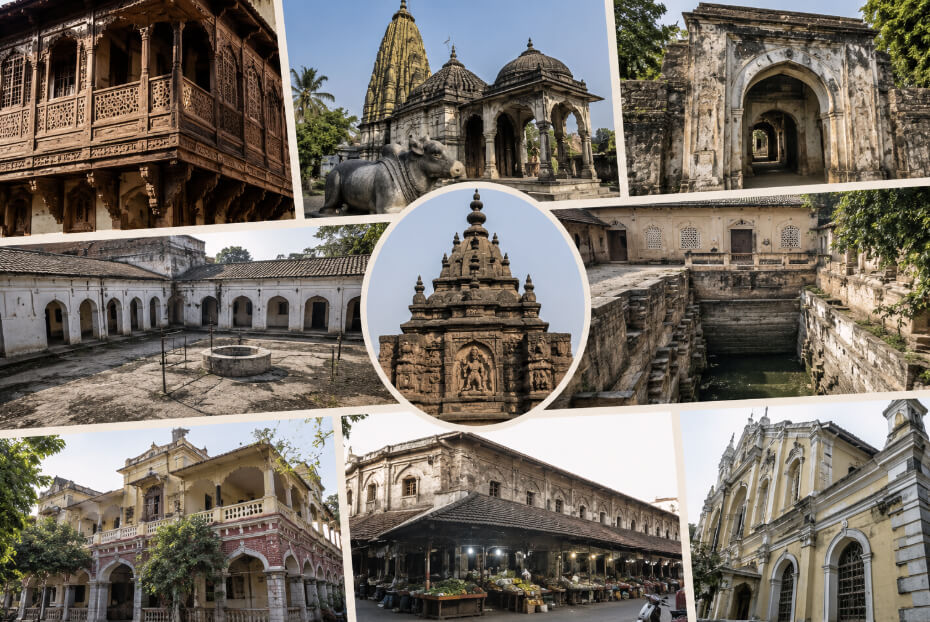
Age alone does not confer legal protection on a historic structure in India. A temple can remain in worship for centuries, a traditional wada can retain rare woodwork, and a century-old institutional building can continue in daily use without becoming a protected monument. Formal status depends on notification under central or state law or inclusion in an applicable municipal heritage list.
That distinction is visible across Vidarbha, where several historically significant structures remain outside the protection frameworks covering better-known monuments. Nagpur's own heritage-listing process considered dozens of additional buildings and precincts but ultimately left them outside the city's recognised list.
Some of those structures still retain architectural features directly connected with the city's older religious, residential, commercial and institutional history.
1. Panzurni Sati Temple, Chandrapur
Panzurni Sati Temple in Warora taluka is a nearly 300-year-old structure associated with a difficult chapter of social history. Unlike many Sati memorials represented by commemorative stones or samadhis, this shrine contains a sculpted representation connected with the practice. The structure displays Rajasthani influences in its stonework and decorative treatment, reflecting cultural links created by Rajput migration into this part of Vidarbha.
Its memorial structure is crowned by five kalashas and contains intricately carved figures that have drawn attention for their sculptural detail. Historical accounts connect the shrine with a family whose ancestors migrated from Rajasthan and later settled at Panzurni, where the temple continues to function as the family's deity shrine.
The family tradition associates the structure with a woman named Navlai, who is believed to have been forced to perform Sati following the death of her husband under the customs prevailing at the time.
A descendant of the family has described the temple as something that must be understood within its historical context rather than as an endorsement of the practice it commemorates. The structure has also been documented in material connected with the Chandrapur district, while the village administration has sought intervention for its upkeep. As recently as January 2026, it was still being described as lacking formal protection despite its continuing religious use and documented architectural significance.
2. Kalikar Mahadev Temple, Nagpur
Kalikar Mahadev Temple is one of the oldest Shiva temples that survives within Nagpur's historic urban area. The temple has been dated to 1764, placing it within the period when the Bhonsles controlled Nagpur and several religious structures were established in and around the old city.
The family associated with the temple historically served as keepers of the Bhonsle privy purse, giving the shrine a direct connection with the administrative life of that period. One of its most prominent features is its unusually large Nandi, described as among the largest found at a temple in Nagpur. The shrine remains a functioning place of worship and continues to receive devotees during major religious occasions, including Mahashivratri. Its historical association and physical features were among the reasons it was put forward for inclusion in Nagpur's heritage list. The temple was nevertheless among the surviving sites that were not recommended for heritage status during the city's prolonged reconsideration of omitted properties.
A 2026 examination of several old Nagpur Shiva temples again placed Kalikar Mahadev among neighbourhood shrines lacking formal heritage recognition and structured conservation support. The Archaeological Survey of India's list for the Nagpur Circle contains 94 centrally protected monuments across Vidarbha, but Kalikar Mahadev is not included under its name.
3. Rajabaksha Hanuman Temple and Stepwell, Nagpur
Rajabaksha Hanuman Temple is a prominent religious site in Nagpur, but the heritage interest of the property extends beyond the temple itself.
The complex contains an old stepwell that was identified during the city's heritage assessment as one of the few remaining structures of its kind in Nagpur. Stepwells historically combined water access with carefully constructed masonry and were once a more common part of settlements across different parts of India. The surviving structure at Rajabaksha therefore adds another architectural layer to a temple that continues to function as a major place of worship.
Historical accounts also associate the temple with visits by members of Nagpur's former ruling establishment before significant undertakings. Its continuing importance can be seen in the large Hanuman Janmotsav procession that started from the temple in 2026 with more than 80 tableaux moving through several parts of the city.
Despite the temple's active use and the survival of its stepwell, both were among the properties left outside Nagpur's municipal heritage list during the re-evaluation of omitted sites. The combination of an operating temple and an old water structure makes the complex different from archaeological monuments that no longer serve their original social functions. No formal central protection for the Rajabaksha temple and stepwell appears in the published list of monuments under the Archaeological Survey of India's Nagpur Circle.
4. Paturkar Ram Mandir, Nagpur
Paturkar Ram Mandir was included among the historic properties considered during Nagpur's long-running debate over expanding its official heritage list.
The structure was identified specifically for architectural features rather than merely because it was an old place of worship. Its construction uses stone, while its interior architectural elements include carved wooden columns and brackets. The combination reflects building practices in which timber craftsmanship formed an important part of the structural and decorative character of religious buildings.
Brackets in such buildings support projecting elements while also providing surfaces for detailed carving, making them an integral part of the architecture rather than separate decoration. The temple was among the surviving properties reconsidered after nine sites from the original group of 49 had already been demolished or had collapsed during the long heritage-listing dispute.
Its architectural features were documented and presented as grounds for heritage recognition. The reconsideration process did not result in Paturkar Ram Mandir being recommended for inclusion in the municipal heritage list. The temple is also absent under its name from the published list of centrally protected monuments administered through the Nagpur Circle.
5. Mohite Gateway, Nagpur
Mohite Gateway is a surviving structure associated with Nagpur's Bhonsle period. It was built by a Bhonsle ruler for his daughter, giving the gateway a documented connection with the city's former ruling establishment and its residential properties. Unlike a fort gateway that formed part of a major defensive system, Mohite Gateway was linked with a more specific property and family history within the old city.
Such surviving gateways can remain after the buildings or compounds with which they were originally associated have been substantially altered. The structure was considered during Nagpur's first major heritage-listing exercise and later formed part of the group whose exclusion was challenged. It survived long enough to be included among the 40 remaining sites that went through another round of consideration after several other omitted properties had disappeared.
The heritage subcommittee examining the group did not recommend Mohite Gateway for inclusion in the city's protected heritage list. Its name is also absent from the Archaeological Survey of India's list of centrally protected monuments for the Nagpur Circle. The gateway consequently occupies the unusual position of being a documented Bhonsle-period structure without a formal protection status that could be verified through the public central and municipal records examined for this article.
6. Denge-Patil Wada, Nagpur
Denge-Patil Wada represents a form of traditional residential architecture that has become increasingly uncommon in Nagpur's old neighbourhoods. A wada is typically organised as a substantial residence built around internal spaces or courtyards, although individual layouts vary according to period, location and ownership. Denge-Patil Wada was singled out during the heritage assessment for its carved wooden balconies projecting over the street.
Its documented features also include additional wood carving, mirrored ceilings and panelled ceilings inside the building. These details make the property's heritage interest different from that of forts or temples because much of its architectural value lies in domestic craftsmanship and interior treatment. Wooden balconies projecting towards a street were also part of the visual character of older dense neighbourhoods, where residential buildings stood directly along narrow urban routes.
The Wada was one of the surviving properties reconsidered after being left outside Nagpur's original heritage list. Despite the detailed architectural elements recorded during that process, it was not recommended for inclusion when the omitted sites were reviewed again. Denge-Patil Wada therefore remains one of the documented examples of old residential architecture in Vidarbha for which formal protection could not be verified in the public records checked.
7. Hathi Khana, Nagpur
Hathi Khana is one of the more unusual structures among the properties that were considered for heritage recognition in Nagpur. Its original function was as an elephant stable, connecting the building with a period when elephants formed part of transport, ceremonial activity and the operations of ruling establishments. The surviving architectural description identifies a square courtyard at the centre of the property. Cells are arranged on all four sides of this courtyard, creating an enclosed functional layout rather than the arrangement expected in a temple or residential wada.
Arched openings form another significant element of the building's recorded design. The structure is important in understanding how specialised buildings were constructed for purposes that have largely disappeared from modern urban life. Hathi Khana was among the properties presented for reconsideration after being omitted from Nagpur's heritage list. Its former use and distinctive arrangement were documented during the process, but the site was not recommended for inclusion.
The Nagpur Hathi Khana does not appear under that identity in the Archaeological Survey of India's list of protected monuments for the Nagpur Circle, although a different structure with the same general name is protected in Agra.
8. Mahal Vegetable Market, Nagpur
Mahal Vegetable Market represents a category of heritage that is often harder to separate from ordinary city life because its historical importance is tied to everyday commerce. The market was identified as part of the Mahal Road precinct, one of Nagpur's oldest continuously used urban areas.
During the heritage-listing proceedings, it was described as the only surviving market of its type in the old city. Unlike a palace or temple, a traditional market acquires much of its historical character through the relationship between permanent structures, surrounding streets, traders and long-established commercial activity. Mahal itself remains an important commercial district where markets continue to operate within a dense network of older roads and buildings.
The vegetable market was among the properties considered for heritage recognition but was left outside the municipal list. It was later included among the surviving sites examined again during the long process triggered by demands for reconsideration. The subsequent review did not recommend it for heritage status. Its exclusion demonstrates that municipal heritage assessments have covered ordinary commercial structures as well as monuments, religious buildings and elite residences, even when those properties ultimately received no formal designation.
9. St Ursula Girls' High School, Nagpur
St Ursula Girls' High School has one of the longest documented institutional histories among the structures considered for addition to Nagpur's heritage list. Its beginnings date to 1857, when a school for girls was started from the verandah of a bungalow under the name Cooper's School. In 1858, the institution was renamed St Ursula Girls' High School with 13 students on its rolls.
By 1871, enrolment had increased to 50 students, and the school received a government grant of ₹25 while Marathi was being used as a medium of instruction. The management of the institution was transferred to a group of women in 1887, and the school's first student passed the matriculation examination in 1907.
It received recognition from Allahabad University five years later. The present historical interest of the property is closely connected with the main building constructed in 1924 as the institution expanded.
That building was specifically included among the sites considered during Nagpur's heritage-listing dispute but was not ultimately recommended for inclusion. The school continues to operate in Civil Lines as St Ursula Girls' High School and Junior College, with its official website listing an active academic calendar for the 2025-26 session.
10. Vithal Rukhmini Temple, Nagpur
Vithal Rukhmini Temple was another religious structure identified during the process of reconsidering buildings left outside Nagpur's heritage list. The temple was documented as being representative of the architecture of its period, which formed the principal architectural basis for its proposed recognition. It also has a historical association with the Koshti community, giving the building a continuing connection with a traditional community in the city.
Community-owned religious structures can remain in active use for generations without entering archaeological protection systems because worship and statutory heritage status operate independently of each other.
The temple was one of several religious buildings in the group of omitted properties, alongside Shiva, Ram and Hanuman temples from different parts of Nagpur. It remained among the structures available for reconsideration after nine other proposed sites had disappeared through demolition or collapse during the years taken by the dispute.
The heritage review did not result in its inclusion in the city's municipal list. It is also not included under the name Vithal Rukhmini Temple in the Archaeological Survey of India's published list for the Nagpur Circle. The available documentation therefore identifies its period architecture and community connection while placing it outside the formal protection records that could be verified publicly.
In Vidarbha, central protection is limited to the monuments formally included in the Archaeological Survey of India's Nagpur Circle list, while state protection requires a separate notification process under Maharashtra law. Municipal heritage status follows another administrative route and can cover buildings that neither the Centre nor the state archaeology department protects. These systems can place structures of comparable age under very different legal categories.
The stories of these buildings also extend beyond famous rulers, battles and major archaeological sites. They include the craftsmen who carved wooden balconies, communities that established places of worship, traders who worked in old markets and students who entered classrooms built generations ago. Many such structures survive within changing neighbourhoods rather than isolated archaeological complexes.
Their history remains embedded in the ordinary functioning of the places around them. As cities and towns continue to change, these buildings remain physical markers of how people once lived, worshipped, worked and built their communities.


Comments