_edited.png)
3 People Challenging Manual Scavenging in Vidarbha Through Ground-Level Work
- Pranay Arya

- Dec 25, 2025
- 4 min read
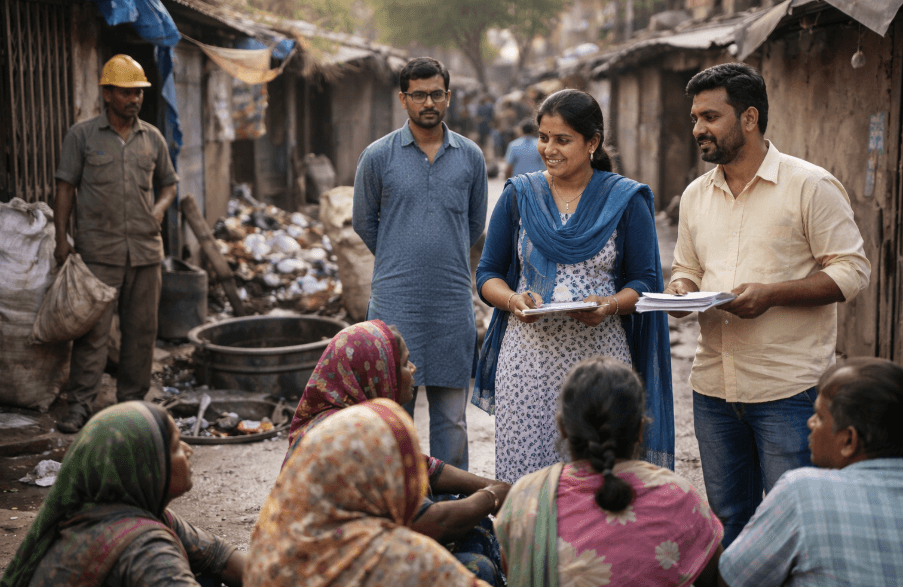
Manual scavenging continues to exist in pockets of India despite being legally prohibited for decades. In parts of Maharashtra, this work has shifted forms rather than disappeared, moving from dry latrines to sewer lines, septic tanks, and informal sanitation labour.
Vidarbha features prominently in this reality due to rapid urban growth, migration-linked labour patterns, and weak enforcement mechanisms.
The issue is not abstract or historical but tied to identifiable settlements, families, and work sites. Across the region, certain individuals have been directly involved in efforts to document this practice, support affected families, and push for rehabilitation.
1. Preeti Pradeep Hajare and community-led rehabilitation efforts in Nagpur
Preeti Pradeep Hajare’s work is rooted in lived experience rather than distant advocacy. She comes from a manual scavenging background and has been directly involved in community work in Nagpur for many years. Her involvement centres on Jan Jagriti Aawahan Bahuuddeshiya Samiti, an organisation registered in 2010 but active before formal registration. The organisation’s activities are focused on families historically engaged in manual scavenging and related sanitation labour. Education forms a core part of this work, particularly aimed at children from these households who are most at risk of being pushed into the same occupation. The emphasis on schooling and day care is not symbolic but designed to interrupt the intergenerational transfer of this work.
Beyond education, her work includes rights awareness sessions where families are informed about legal protections, welfare provisions, and the prohibition of manual scavenging. These sessions are often conducted within settlements where sanitation workers live, making access easier for women and elderly family members. Health support also forms a documented part of this effort, with links created to medical camps and clinics due to the high prevalence of skin infections, respiratory issues, and chronic illnesses among sanitation workers. Skill development initiatives have been used to help younger members of these families move towards alternative livelihoods. This includes training in basic trades and assistance in navigating certification or placement processes.
Her work in Nagpur is often cited as extending to the surrounding areas of Vidarbha through outreach and collaboration with similar groups. The focus remains consistently on families rather than statistics, keeping the issue grounded in everyday realities.
2. Pradeep Balwant Hajare and local mobilisation against hereditary sanitation labour
Pradeep Balwant Hajare has worked alongside Preeti Hajare and shares a similar personal connection to the issue of manual scavenging. His role within Jan Jagriti Aawahan Bahuuddeshiya Samiti involves direct engagement with adults and youth from sanitation worker communities. Much of his work focuses on awareness programmes that address caste-based discrimination and the normalisation of hereditary sanitation labour. These sessions are conducted in simple language and often include discussions on untouchability and social exclusion faced by these families. Parents are encouraged to reflect on how social pressure and economic vulnerability shape occupational choices for their children.
Workshops organised under his involvement frequently include information on existing laws that ban manual scavenging and hazardous sanitation work. The intent is to ensure that families understand their rights and the illegality of the work they are often forced into. He has also been involved in coordinating community meetings during visits by national-level anti-manual scavenging activists, linking local struggles to wider movements. This connection helps local groups articulate their experiences within a broader legal and social framework. His efforts also include engagement with youth who seek to leave sanitation work but face resistance from employers or contractors. Guidance is provided on documentation, identity proof, and basic bureaucratic processes that often act as barriers.
Health and welfare linkages are another documented aspect of his work. Many families engaged in sanitation labour remain excluded from welfare schemes due to a lack of paperwork or awareness. Assisting families in accessing these schemes becomes part of rehabilitation, even though it does not replace the need for livelihood change. His work remains concentrated in Nagpur while being connected to networks operating across Vidarbha. The emphasis throughout is on collective participation rather than individual success stories.
3. Bezwada Wilson and nationwide movement networks reaching Maharashtra
Bezwada Wilson is widely recognised for his role in the Safai Karmachari Andolan, a movement that has campaigned against manual scavenging across India. While his work is national in scope, it has direct relevance to Maharashtra through movement networks and documented visits. The Safai Karmachari Andolan has played a role in expanding the definition of manual scavenging to include sewer and septic tank cleaning. This framing is particularly relevant to urban centres like Nagpur, where sanitation work increasingly involves hazardous underground labour. The movement has focused on identifying dry latrines, documenting illegal employment, and pushing for enforcement of existing laws.
In Maharashtra, the movement’s work includes supporting local groups through legal advocacy and public campaigns. These efforts have helped bring attention to deaths caused by sewer and septic tank cleaning, which are often underreported. Bezwada Wilson’s engagement with communities in Nagpur has been referenced in the context of mobilisation events and awareness drives. Such visits help reinforce the idea that local struggles are part of a national pattern rather than isolated incidents. The movement has also emphasised rehabilitation as a legal obligation rather than charity.
Documentation forms a major component of this work, with surveys and reports used to challenge official claims of eradication. This approach has influenced how manual scavenging is discussed in policy and legal spaces. The emphasis on accountability has led to court cases and public scrutiny of sanitation practices. In Vidarbha, this framework supports local organisations by providing legal language and national visibility. The movement’s focus on dignity and safety aligns closely with the realities faced by sanitation workers in rapidly urbanising towns. Its presence strengthens local efforts by situating them within a sustained national campaign.
The work of these three individuals reflects different but interconnected approaches to addressing manual scavenging. One approach is rooted in lived experience and daily engagement with affected families. Another focuses on community mobilisation and awareness within local settlements. The third operates at a national level while maintaining touchpoints with local struggles.
Together, they show how the issue operates across scales rather than in isolation. Vidarbha appears repeatedly in these efforts due to its mix of urban growth, migration, and entrenched caste-based labour patterns. Understanding these contributions helps place the problem of manual scavenging within a concrete regional context rather than abstract policy debates. The persistence of this work highlights how deeply the practice is embedded and how complex its dismantling remains.


Comments