_edited.png)
4 Failures of Nagpur Municipal Corporation in 2025

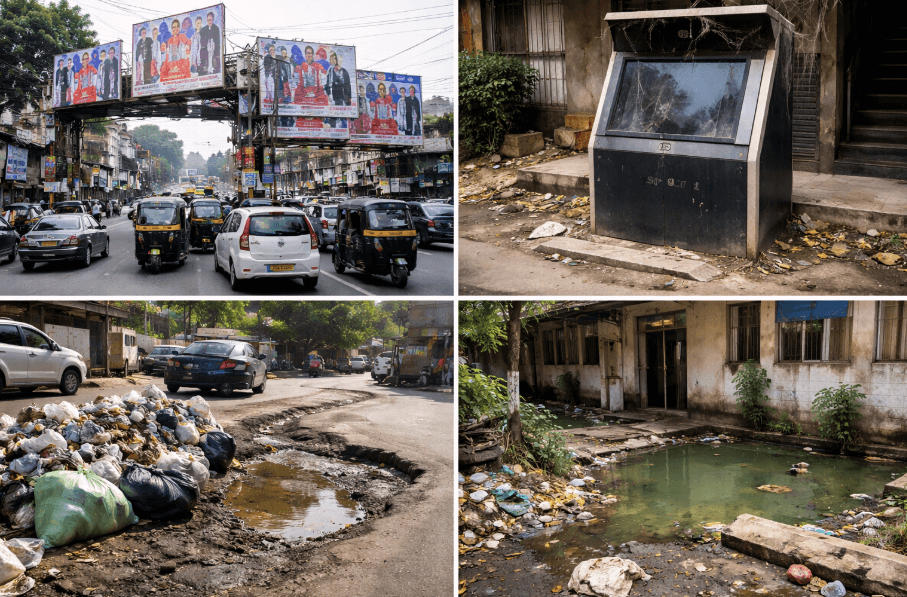
Urban governance in Nagpur during 2025 drew steady public attention for reasons that went beyond routine civic administration. Across neighbourhoods, junctions, and public facilities, residents encountered repeated signs of breakdowns in basic municipal functioning.
These issues did not emerge suddenly but became visible through everyday experiences such as commuting, accessing public health services, or attempting to register civic complaints.
The concerns reflected gaps in enforcement, maintenance, coordination, and follow through across departments. For a city that serves as a major administrative and economic centre of Vidarbha, these failures carried wider regional relevance.
1. Proliferation of Illegal Hoardings and Weak Enforcement
Throughout 2025, unauthorised hoardings and banners became a recurring sight across major intersections and arterial roads in Nagpur. These structures appeared on traffic dividers, near signals, and along footpaths, often obstructing visibility for motorists and pedestrians. Civic rules require removal of such hoardings within a fixed timeframe, particularly during election periods, yet enforcement remained inconsistent. Reports noted that many hoardings stayed in place for days despite clear violations of municipal norms. Some installations were fixed to electric poles and road infrastructure, raising safety concerns during storms and heavy winds. The responsibility for monitoring and removal fell across multiple departments, leading to delayed action and overlapping accountability. This pattern reflected a broader enforcement failure that affected public spaces across the city and added to visual clutter in several Vidarbha urban corridors connected to Nagpur.
2. Non-Functional Smart City Kiosks and Infrastructure Neglect
Nagpur’s Smart City programme included the installation of digital kiosks intended to provide civic information and online services to residents. By 2025, a significant number of these kiosks were found to be non-operational. Several units were reportedly covered in dust, with screens inactive and internal systems never commissioned after installation. The kiosks were placed at prominent public locations, including markets and transit zones, yet remained unused for extended periods. Maintenance contracts and operational responsibility were unclear, resulting in no regular checks or servicing. Public funds allocated for digital outreach thus failed to translate into functional infrastructure. The condition of these kiosks became a visible marker of planning gaps and weak post installation monitoring. Within Vidarbha, where Nagpur often serves as a reference point for urban initiatives, this lapse carried symbolic weight regarding the execution of technology-driven civic projects.
3. Large Backlog in Civic Complaint Redressal
Data released during 2025 showed a sharp mismatch between the number of civic complaints registered and those resolved within stipulated timelines. Complaints related to garbage accumulation, drainage blockages, potholes, and water supply disruptions formed a substantial share of pending cases. Over a defined period, tens of thousands of grievances were logged through official channels, including online portals and ward offices. Only a portion of these complaints were marked as resolved, leaving a significant backlog across departments. Residents reported repeated follow ups for the same issues without closure. Internal coordination between field staff and supervisory units appeared strained, contributing to delays. The persistence of unresolved complaints pointed to systemic capacity constraints rather than isolated lapses. For surrounding towns in Vidarbha that depend on Nagpur’s administrative models, this backlog raised questions about
the scalability of grievance systems.
4. Deterioration of Sanitation at a Public Health Facility
One of the most serious civic failures recorded in 2025 concerned sanitation conditions at a municipal dispensary located on a major city road. The facility premises reportedly experienced prolonged water stagnation, sewage overflow, and accumulation of waste. These conditions created a favourable environment for mosquito breeding, posing health risks to patients and staff alike. The issue was not limited to a single incident but persisted over several weeks. Despite the dispensary serving local residents for basic healthcare needs, routine sanitation and drainage maintenance were not carried out effectively. The surrounding area also suffered due to the spillover of stagnant water onto access paths.
This lapse highlighted weaknesses in coordination between health and sanitation departments. As Nagpur functions as a healthcare hub for parts of Vidarbha, neglect at such facilities has implications beyond the immediate locality.
The four failures outlined above present a snapshot of civic administration challenges faced by Nagpur in 2025. Each case reflects documented lapses in enforcement, maintenance, service delivery, or interdepartmental coordination.
These were not abstract policy issues but tangible problems encountered daily by residents across different parts of the city. The incidents also illustrate how gaps in urban governance become visible through public infrastructure and basic services. For a city that influences planning approaches across Vidarbha, such failures attracted close public scrutiny.
Recording these developments in a factual manner is essential to understanding the operational state of municipal systems during the year. This account remains limited to verified reports and observed outcomes without extending into interpretation or advocacy.


Comments