_edited.png)
4 Great Archaeologists from Vidarbha

Updated: Feb 12
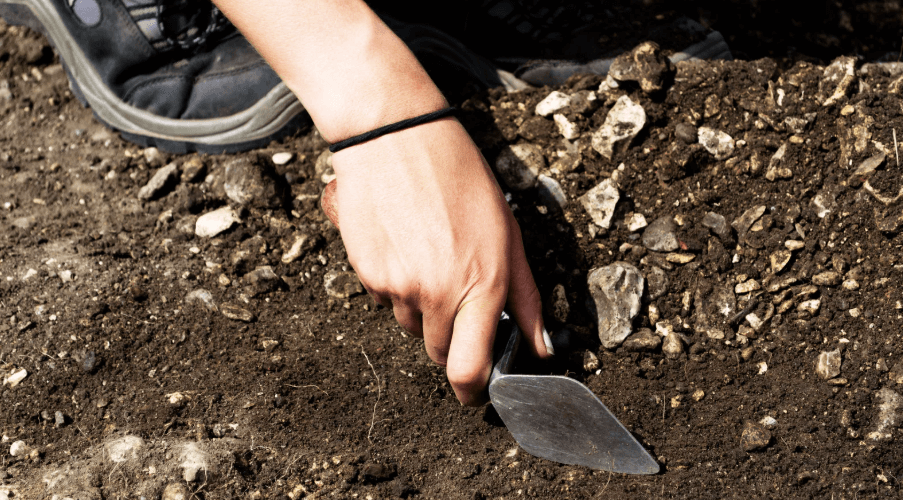
The study of Vidarbha’s past has been shaped by a small group of scholars who devoted their careers to uncovering ancient sites, inscriptions, and artefacts across the region. Their work extended from systematic excavations of megalithic burial sites to deciphering copper plates that revealed details of political history.
These archaeologists were also responsible for building institutional capacity, publishing detailed reports, and mentoring future researchers. Each of them left a significant imprint on how Vidarbha’s archaeology is understood today.
Their efforts established a research base that continues to influence investigations into the Deccan’s cultural and historical development.
1. S. B. Deo
S. B. Deo is regarded as a pioneer in Vidarbha’s archaeological research, particularly in the study of megalithic sites. He began systematic explorations in the late 1960s through Nagpur University’s Department of Ancient Indian History, Culture and Archaeology. Among his most important field contributions were excavations at Takalghat and Khapa, sites which later produced crucial radiocarbon dates that helped establish a chronological framework for the region’s Iron Age. Deo also directed excavations at Mahurjhari in the early 1970s, where hundreds of megalithic burials were documented along with associated pottery and artefacts.
His work at Pauni, conducted with J. P. Joshi in 1969–70, further advanced understanding of the region’s transition into early historic urban centres. Academic sources note that he published detailed excavation reports that remain standard references. His leadership at Nagpur University encouraged students and young scholars to pursue fieldwork, creating continuity in regional research. These projects placed Vidarbha firmly on the archaeological map of India.
2. A. M. Shastri
Ajay Mitra Shastri, who taught at Nagpur University, was a historian, numismatist, and archaeologist who contributed to the study of Vidarbha through both field and textual research. Departmental records list him as the director of excavations at Mandhal, Arni, and Tharsa, sites that yielded early historic material culture. He was instrumental in building the University’s archaeology museum, which preserved and displayed finds from Vidarbha excavations. Shastri’s wider scholarship extended to numismatics and the political history of the Deccan, where he examined coinage and inscriptions to reconstruct trade and administration.
His colleagues recognised his role in strengthening the University’s academic resources, including pushing for a dedicated museum space. Published works under his name focused on interpreting early historic developments in central India, with Vidarbha forming an important part of his research area. While best known as a historian, his role in regional archaeology remains significant through the excavations he supervised and the academic structures he helped consolidate.
3. V. V. Mirashi
Vasudev Vishnu Mirashi was one of India’s foremost epigraphists, and his association with Vidarbha’s historical research is widely acknowledged. He specialised in Sanskrit inscriptions and edited several corpora, including those of the Vakataka dynasty. His readings of copper plate grants, such as the Tirodi plates, are still cited as authoritative. Though not primarily a field excavator, his contribution lay in establishing the political and cultural history of Vidarbha through inscriptional analysis. Born in Amravati district and associated with Nagpur institutions, Mirashi worked extensively on reconstructing the chronology and genealogy of the Vakatakas, who ruled large parts of central India in the fourth and fifth centuries CE.
His scholarship extended to other dynasties as well, but the Vidarbha material remains central to his published output. Colleagues in later generations have described his editions of inscriptions as standard references. Through his meticulous epigraphic work, Mirashi anchored Vidarbha’s historical research in verified primary sources.
4. P. S. Meshram
P. S. Meshram, affiliated with Nagpur University, has been an active field archaeologist and researcher of Vidarbha’s material culture. Departmental records show his involvement in excavations at sites such as Vyahad in Nagpur district and Gawarala in Chandrapur, with further work across other districts, including Yavatmal. His academic focus included terracotta artefacts and material cultures of early cave sites in Maharashtra. Publications by Meshram discuss finds such as a Roman bulla recovered at Paunar and terracotta figurines that reflect cultural interactions in Vidarbha.
He also contributed to collaborative research on iron artefacts from megalithic sites like Dhamna Linga and Dhaulameti, expanding knowledge of technological practices in the region. His published work appears in academic journals and conference proceedings, linking field discoveries with wider interpretive frameworks. Through sustained participation in excavation teams and research publications, Meshram has enriched the study of Vidarbha’s archaeology and material culture in the late twentieth century.
The careers of S. B. Deo, A. M. Shastri, V. V. Mirashi, and P. S. Meshram highlight different dimensions of Vidarbha’s archaeological scholarship. Some focused on field excavation, others on epigraphy and numismatics, while still others specialised in material culture studies. Together, they created a foundation for understanding the region’s past that combined excavated evidence with inscriptions and artefacts.
Their work was anchored in institutions like Nagpur University, which became a hub for archaeological training and research. The details of their contributions show how the study of Vidarbha developed through individual commitment and institutional support. These archaeologists left a record of scholarship that continues to be used in contemporary research, keeping Vidarbha central to discussions of Indian archaeology and history.


first 3 are correct but there are more deserving people