_edited.png)
How Biofuel Policy Is Transforming Crops and Energy in Vidarbha

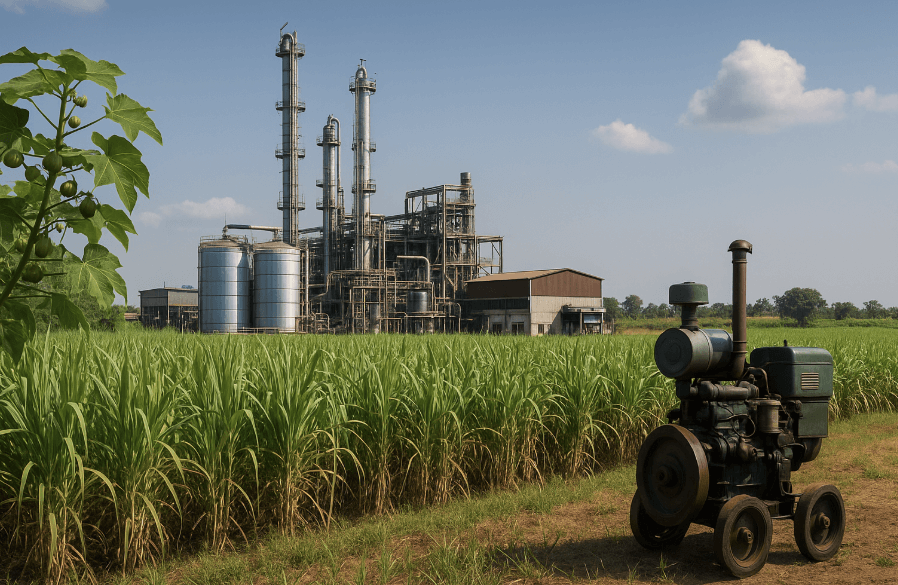
Farmers in Maharashtra’s Vidarbha region are planting more than just food crops these days. India’s National Biofuel Policy is encouraging the cultivation of plants that can be turned into fuel, spurring interest in everything from sugarcane to bamboo.
This policy-driven shift is not only about what grows in the fields, but it is also about new ethanol distilleries and bringing renewable energy options to rural markets.
Vidarbha’s agriculture and rural economy stands at the cusp of change, as the region tries to seize opportunities in feedstock cultivation, ethanol production, and biofuel-based rural energy. The push for green fuels promises economic benefits to this largely agrarian belt, even as it tests the limits of local resources and infrastructure.
Cultivating Biofuel Crops in Vidarbha
India’s biofuel ambitions rest on what farmers grow. The National Policy on Biofuels (first introduced in 2009 and updated in 2018) expanded the range of feedstocks that can be used for energy.
Once limited to sugarcane byproducts, ethanol can now be produced from surplus grain harvests like maize and rice, while biodiesel can come from non-edible oils and waste fats. This broad mandate means Vidarbha’s diverse agriculture could play a bigger role.
In practice, it translates into new crops and uses for old ones on the region’s farms.
One notable initiative was the promotion of Jatropha curcas, a hardy shrub whose oil-rich seeds can be turned into biodiesel. In the mid-2000s, jatropha was hyped as a “miracle” biofuel crop that could thrive on marginal land with little water. It was touted as a way for farmers to earn extra income from wastelands without displacing food crops. Maharashtra, including parts of Vidarbha, planted jatropha saplings under government schemes at the time. However, the boom quickly fizzled out. By 2008, low yields and poor planning led to widespread failures.
The jatropha crash offered a cautionary tale that even a drought-tolerant plant needs proper cultivation methods and realistic expectations. Today, researchers still see potential in improved jatropha varieties, but the initial exuberance has given way to caution. For Vidarbha’s farmers, the lesson was that not every biofuel feedstock will be a silver bullet.
Despite that setback, other feedstock opportunities are coming to the fore. Vidarbha is a major cotton-growing region, and cottonseed, usually a byproduct for animal feed or cooking oil, contains about 13 percent oil that can be converted into biodiesel. One scientific study calculated that in a single recent year, Vidarbha’s cotton harvest yielded over 66 million kilograms of cottonseed oil, a volume potentially “sufficient for biodiesel production if not used for edible purposes”.
While cottonseed oil is edible and largely goes into the food industry, this figure highlights the sheer scale of biofuel raw material that exists in the region’s agriculture. Similarly, used cooking oil from restaurants in Vidarbha’s cities is now being collected under a national program to be processed into biodiesel, a small but growing effort to tap urban waste for rural fuel.
Another crop drawing attention is bamboo, which grows abundantly in parts of Vidarbha, especially in its eastern forests. Bamboo is a fast-growing grass that doesn’t compete with food crops. Recent advances have shown it can be turned into cellulosic ethanol, a second-generation biofuel. In fact, India’s first commercial 2G ethanol biorefinery, opened in 2022 in Assam, uses bamboo as its primary feedstock.
Every year, this refinery will consume about 500,000 tonnes of raw bamboo to produce an estimated 50,000 tonnes of ethanol along with valuable chemicals like acetic acid and furfural.
The plant operators even distributed millions of bamboo saplings to local farmers to ensure a steady supply, demonstrating how cultivation and fuel production can be linked. Seeing this success, officials and industry leaders in Maharashtra have started talking about Vidarbha as a potential hub for bamboo-based biofuels.
The region’s climate and terrain are well-suited for bamboo, and local entrepreneurs are exploring tie-ups to supply biomass.
Early this year, a senior minister from the region highlighted a plan to make aviation fuel from bamboo ethanol, explicitly saying that aviation turbine fuel will be made from bamboo and Vidarbha can be its hub.
This reflects a broader confidence that with the right technology, Vidarbha’s green fields and even its scrublands can feed into India’s clean energy future.
Ethanol Production: A New Lifeline for Industry
The clearest impact of the National Biofuel Policy is seen in ethanol production, which has ramped up nationwide.
The policy’s flagship Ethanol Blending Programme targets 20 percent ethanol in petrol by 2025, an ambitious jump from the single-digit blend levels of just a few years ago.
Ethanol in India is mostly made from sugarcane byproducts, molasses and even direct juice, so the push for fuel is felt keenly in sugar-growing areas. Maharashtra is India’s second-largest sugar producer, and even though Vidarbha is not part of the state’s traditional sugarcane belt, it does have pockets of cultivation.
Districts in western Vidarbha, like Buldhana and Yavatmal, host a number of sugar mills, which until now focused on making sugar. With the new policy, these mills are expanding or retrofitting to distil ethanol from molasses and cane juice. The government has sweetened the deal by offering higher purchase prices for ethanol derived from sugarcane, aiming to make it attractive for mills to supply fuel instead of just sugar. For the first time, these factories have a dual market: they can produce sugar for food or divert cane towards ethanol production, depending on what is more profitable.
Many farmers are viewing this as a welcome development. In places like Buldhana and Yavatmal, sugarcane farmers traditionally had only one buyer, the sugar mill, and were at the mercy of volatile sugar prices and delayed payments. Now, the ethanol programme could ensure more consistent demand and potentially better prices for their crop.
If mills pay on time under the Fair and Remunerative Price system, higher ethanol demand could translate into higher incomes for cultivators. “It’s an additional revenue stream for us,” says a farmer from Yavatmal who hopes part of his harvest can go into fuel alcohol if sugar yields are in surplus. Local authorities have noted a slight uptick in sugarcane planting as farmers respond to these incentives.
The policy, however, comes with complex trade-offs. Sugarcane is a water-intensive crop, and Vidarbha’s climate is defined by hot summers and erratic rainfall. Producing a single litre of ethanol from sugarcane requires roughly 2,860 litres of water, an astounding figure in a region where water is precious.
Studies show that about 82 percent of India’s sugarcane is grown in low-rainfall or drought-prone areas, including parts of Vidarbha, despite experts advising against large-scale cane cultivation in such zones.
This raises concerns that chasing ethanol targets could strain groundwater and reservoirs. In Buldhana and Yavatmal, many farmers rely on borewells and seasonal canals that are already stretched. Expanding sugarcane acreage might deepen water scarcity for the wider community and even for other crops like cotton and soybeans that share the same resources.
The sugar mills, too, need water for crushing and distilling, so any ethanol boom must be balanced with improved irrigation efficiency and water management. State agricultural officials have started advising growers on more efficient drip irrigation for cane fields to tackle this issue.
There is also a question of policy consistency. In years when sugar production falls short of domestic needs, the central government has occasionally restricted the use of sugar syrup or cane juice for ethanol to ensure enough sugar is available in the market. Such sudden policy shifts create uncertainty for both farmers and mill owners.
A mill in Vidarbha that invested in an ethanol plant has to gamble on these rules each season. A sudden ban could leave them unable to use their cane juice for fuel, cutting into expected revenues. “This unpredictability makes planning difficult,” admits an executive at a Buldhana sugar cooperative, noting that they expanded capacity for ethanol but worry whether they can utilise it fully every year.
Despite these challenges, the overall direction is clear: ethanol has emerged as a new lifeline for the sugar industry. As India races toward the 2025 blending target, even non-traditional regions like Vidarbha are contributing to the supply. The hope is that with proper safeguards, this will be a win-win, stabilising farmer incomes and creating rural jobs, while reducing fossil fuel imports and emissions.
Not all ethanol in Vidarbha will come from sugarcane, though. The National Biofuel Policy’s 2022 amendment opened the door for making ethanol from damaged food grains and agricultural waste in ethanol-deficient states.
In the paddy-growing districts of eastern Vidarbha, like Bhandara and Gondia, there is interest in setting up grain-based ethanol units using surplus rice or maize that isn’t fit for sale. Additionally, the second-generation ethanol projects on the horizon could leverage crop residues such as rice straw or cotton stalk and bamboo, as discussed earlier.
A proposal is underway to establish a modern bio-refinery in the Vidarbha region that would use bamboo or farm waste to produce ethanol and other bio-based chemicals.
Such a facility, if it materialises, would create a new market for biomass that is otherwise burned or left to rot. The convergence of technology and policy support is gradually transforming ethanol from a niche byproduct into a major rural industry.
In Vidarbha, what began as a distant government mandate is now visible on the ground in taller stacks of cane at the factory gate, in new storage tanks gleaming in the summer sun, and in the cautious optimism of farmers who see fuel blending as a chance to revitalise their fortunes.
Biofuels and Rural Energy Markets
Beyond farms and factories, biofuels are quietly making inroads into rural energy markets, the places where villagers and small businesses get their power and fuel.
One of the policy’s less-publicised aims is to enhance energy access in rural areas by using local bio-resources. Vidarbha, with its mix of agrarian communities and remote tribal villages, stands to gain if biofuels can be deployed for decentralised energy.
Instead of depending solely on grid electricity or expensive diesel, villages could use locally produced ethanol or biodiesel to run generators, farm equipment, and even cooking stoves. Recent examples show this is more than a theory.
In 2006, a small tribal village in neighbouring Chhattisgarh became India’s first to be fully electrified with biofuel. Authorities supplied farmers there with 60,000 jatropha saplings, and within two years, the jatropha seeds were being pressed into oil to fuel diesel generators. For the first time, that village’s 1,000-odd residents had reliable power for lighting and irrigation pumps, all powered by plants grown on their own land. It was a pioneering model of a rural community using home-grown energy, and it showed that biofuels could indeed light up lives in off-grid areas.
Fast forward to today, and new pilot projects build on that legacy with more advanced tech. Companies and NGOs have introduced mini biodiesel units in some parts of India, which could be replicated in Vidarbha. These units can take locally collected raw materials, for example, used cooking oil, pungam karanj oil seeds, or animal fats, and refine them into biodiesel on a small scale.
The fuel can then run village generators or even tractors and water pumps. Advocates say this decentralised model not only brings energy independence but also creates local jobs in operating and maintaining the equipment. A recent success story from another Indian state described how a remote village achieved 24×7 electricity by installing a community-run biofuel generator.
Women’s self-help groups were trained to collect waste oils and produce biodiesel, which in turn powered microgrids for the village homes. “Now our children can study under electric lights, and we don’t fear power cuts anymore,” one resident proudly noted. Although Vidarbha’s villages face different conditions, such stories are inspiring local organisers to consider biofuel as a solution for energy poverty in the region’s interior.
Several factors make biofuels appealing for rural India, including Vidarbha’s communities:
Local Resources: Villages naturally generate a lot of organic waste, from crop stubble to cow dung to used vegetable oil. With proper processing, these can be turned into valuable fuel on-site. This means energy production can rely on an existing supply chain of rural by-products rather than imported oil.
Small-Scale Production: Setting up a biofuel plant does not require massive infrastructure like a coal power station would. Compact biorefineries or biogas digesters can be scaled to the community’s size. This lower cost and scalability make them practical for villages and farm co-operatives.
Environmental Benefits: By replacing or mixing with diesel, biofuels cut down on soot and carbon emissions. Rural areas that switch their generators or water pumps to biofuel notice cleaner air and less smoke, an important health benefit in communities that often rely on smoky diesel gensets or wood fires. Waste that would pollute such as crop residue burning is also put to good use, aiding local environmental management.
Multiple Uses: A big advantage is versatility. The same biofuel can run an irrigation pump, a grain mill engine, or a power generator, and even fuel modified cooking stoves. This flexibility is crucial where people need energy for diverse daily tasks but often lack reliable supply. In Vidarbha’s rural heartland, a drum of biodiesel could mean electricity at night, easier harvesting, and cheaper transport, a broad boost to quality of life.
There are emerging businesses tapping into this opportunity by linking Vidarbha’s agricultural biomass to energy markets. A case in point is a startup founded by two engineers originally from the Amravati district.
Noticing the heaps of post-harvest waste in soybean and cotton fields, they began converting soybean husk and other residues into briquettes and pellets, a form of solid biofuel that can replace coal. Initially sceptical, they tested these farm-waste briquettes with a factory in Nagpur and found enthusiastic buyers.
Today, their venture collects agro-waste from Vidarbha’s farms and processes it into standardised biofuel blocks, supplying them to industries as far as Pune.
This not only provides farmers a bit of extra income for material that was previously burned off, but also creates cleaner fuel for factories. Such biomass briquettes are in growing demand by companies trying to reduce their carbon footprint. In fact, when India announced a Global Biofuels Alliance at the 2023 G20 summit, it spotlighted an estimated ₹4,153 billion market opportunity opening up for biofuel enterprises.
Entrepreneurs in Vidarbha are positioning themselves to capture a slice of that market, leveraging the region’s raw material advantage. “Biofuels are a sunrise sector for various reasons,” notes one of the startup founders, pointing to the gap in supply and demand for green fuel alternatives. The presence of these innovative projects signals that rural-focused biofuel development is not just about policy but about grassroots initiative.
To be sure, challenges remain in bringing biofuel to rural markets at scale. There is a need for training and support so that villagers can run and maintain biofuel equipment safely. The initial funding for setting up small plants or purchasing machinery can be a hurdle without government or NGO assistance. And while the technology has improved, not every biofuel solution will be suitable for every village. Factors like the type of local waste, climate, and community buy-in matter greatly. Yet, the experiments in Vidarbha and nearby regions so far have been promising.
They illustrate a future where energy is produced and consumed locally, looping rural economies into the clean energy transition. For a region like Vidarbha, which has often been in the news for agrarian distress, these developments offer a different narrative, one of innovation and self-reliance, rooted in the very soil of the countryside.
From the green stalks of sugarcane swaying in Vidarbha’s fields to the hum of a generator in a remote hamlet, the National Biofuel Policy is starting to make its presence felt on the ground.
It has sparked a search for new feedstock crops, driven investment into ethanol distilleries, and opened conversations about energy independence in villages.
The journey is just beginning, and it is by no means free of hurdles: farmers must learn from past setbacks like jatropha, industries must manage resources sustainably, and communities need support to adopt new technology. Yet, there is a palpable sense of possibility in the region. Vidarbha’s role in India’s clean fuel saga may historically have been small, but it is growing bit by bit, in experimental bamboo plots, retrofitted sugar factories, and pilot projects lighting up rural homes.
As one agricultural expert put it, “biofuels won’t solve all of rural India’s problems, but they add a new option where there were few.” In Vidarbha, that option is empowering farmers to diversify their livelihoods and enabling villages to chart their own energy future.
The coming years will reveal how much of this promise can be realised. For now, the seeds of change have quite literally been planted, and an age of home-grown energy is gradually taking root alongside the cotton and oranges in Vidarbha’s countryside.
References
The News Dirt. (2024). India’s ethanol blending push: Impact on Vidarbha’s sugarcane farmers. https://www.thenewsdirt.com/post/india-s-ethanol-blending-push-impact-on-vidarbha-s-sugarcane-farmers
Times of India. (2024). ATF from bamboo in Vidarbha hub, says Gadkari. https://timesofindia.indiatimes.com/city/nagpur/atf-from-bamboo-in-vidarbha-hub-says-gadkari/articleshow/107196423.cms
Urunkar, S. (2023). Startup mantra: Scripting success with green energy. Hindustan Times.https://www.hindustantimes.com/cities/pune-news/startup-mantra-scripting-success-with-green-energy-101695410126730.html
Dindorkar, S. K., Mahalle, D. M., & Bhoyar, S. (2008). Evaluation of cottonseed oil for biodiesel production. International Journal of Agricultural Engineering, 1(2), 45–48.https://researchjournal.co.in/online/IJAE/IJAE%201(2)/1_A-45-48.pdf
Das, R. K. (2006). Chhattisgarh village chooses bio-fuel. Business Standard.https://www.business-standard.com/article/companies/chhattisgarh-village-chooses-bio-fuel-106122201036_1.html
Mowbray, S. (2023). Jatropha: The biofuel that bombed seeks a path to redemption. Mongabay India.https://news.mongabay.com/2023/04/jatropha-the-biofuel-that-bombed-seeks-a-path-to-redemption/
Wikipedia contributors. (2023). Jatropha biodiesel in India. Wikipedia.https://en.wikipedia.org/wiki/Jatropha_biodiesel_in_India
USDA Foreign Agricultural Service. (2025). Biofuels annual: India (Report No. IN2025-0031).https://apps.fas.usda.gov/newgainapi/api/Report/DownloadReportByFileName?fileName=Biofuels%20Annual_New%20Delhi_India_IN2025-0031.pdf
Down To Earth. (2023). OIL lines up Rs 2000 crore SAF plant and bets on bamboo ethanol to fuel its green transition.https://www.downtoearth.org.in/energy/oil-lines-up-rs-2000-crore-saf-plant-and-bets-on-bamboo-ethanol-to-fuel-its-green-transition
Advance Biofuel. (2023). How a small village in India became energy independent with biofuels.https://advancebiofuel.in/india-village-biofuel-independence/


Comments