_edited.png)
Paunar in Vidarbha: Untold History from Ancient Capital to Social Reform Hub

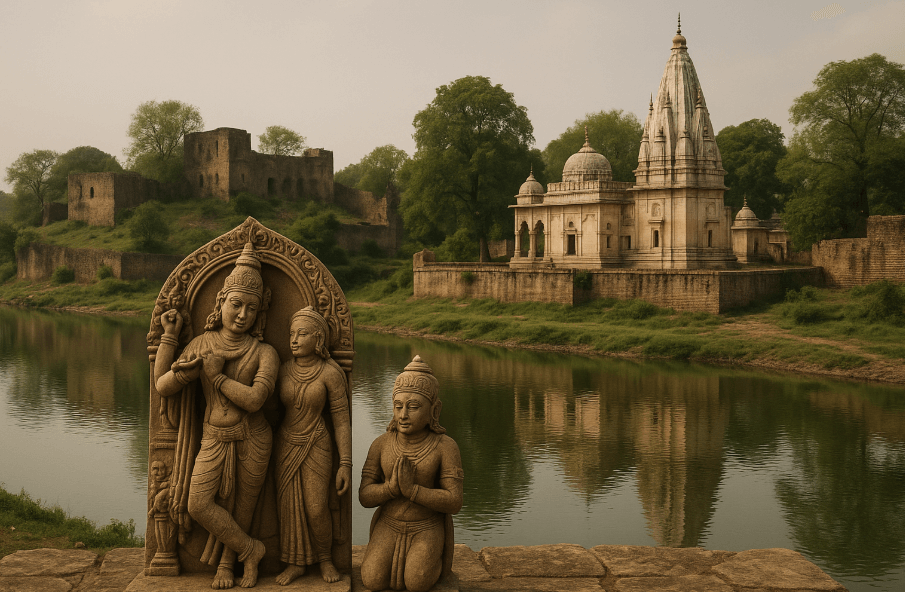
Paunar stands as one of the most historically significant villages in Vidarbha, representing a unique confluence of ancient heritage and modern spiritual movements.
Located on the banks of the Dham River in Wardha district, this small settlement has played crucial roles across different historical periods, from serving as the capital of the mighty Vakataka dynasty to becoming the spiritual headquarters of Vinoba Bhave's social reform movements in the 20th century.
The village's strategic position along ancient trade routes and its fertile location on the riverbank made it an attractive site for successive civilisations. Archaeological excavations have revealed continuous human habitation spanning over three millennia, making Paunar one of the most archaeologically rich sites in central India. The discovery of ancient sculptures, inscriptions, and structural remains has provided invaluable insights into the religious, cultural, and political life of medieval India.
Modern Paunar gained prominence as the home of Paramdham Ashram, established by Acharya Vinoba Bhave in 1938. From this peaceful retreat, Bhave launched the revolutionary Bhoodan movement in 1951, which aimed to redistribute land to the landless through voluntary donations.
The ashram continues to function as a centre for Gandhian philosophy and social reform, attracting visitors from across the globe who seek to understand the principles of non-violent social transformation.
Ancient Paunar: Capital of the Vakatakas
Paunar's ancient history traces back to its identification with Pravarapura, the capital city established by Pravarasena II of the Vakataka dynasty during the 5th century CE.
Pravarasena II, the youngest son of Rudrasena II and the Gupta princess Prabhavatigupta, shifted his capital from Nandivardhan to this new city around 422 CE.
Archaeological excavations conducted since the 1960s have uncovered a remarkable sequence of cultural phases at Paunar.
The earliest phase, dated to 1000-800 BCE, is characterised by distinctive black and red pottery and coarse red ware with black paintings that appear to be unique to parts of Vidarbha. This pre-iron age settlement evolved through subsequent periods, with the introduction of full-fledged iron technology marking the second phase around the 4th century BCE.
The third period, corresponding to the Vakataka era, witnessed the introduction of kiln-burnt brick structures and sophisticated pottery. During this time, the site flourished as Pravarapura, with Pravarasena II constructing a magnificent temple dedicated to Ramchandra.
The king's devotion to Vishnu, likely influenced by his mother Prabhavatigupta, who was a devout Vaishnava, resulted in the creation of elaborate sculptural panels depicting scenes from the Ramayana.
The discovered sculptures include remarkable representations of the Rama-Bharata meeting, with Sita and Lakshmana nearby, as well as panels illustrating the Sugriva-Vali fight and Ramajanma. These 1,500-year-old artistic masterpieces demonstrate the high level of sculptural skill achieved during the Vakataka period.
The temple complex also housed sculptures of Ganga and various other deities, reflecting the syncretic religious practices of the time.
Archaeological evidence suggests that Pravarapura was a planned urban settlement with sophisticated infrastructure.
Excavations have revealed residential structures, fortified walls, and evidence of administrative activities, including the discovery of clay seals bearing official inscriptions.
The site's strategic importance is further emphasised by references in historical texts, including the Ain-i-Akbari of Abul Fazl, which mentions the fort at Paunar as a significant stronghold.
Medieval Period and Islamic Rule
Following the decline of the Vakataka dynasty, Paunar continued to maintain its strategic importance through successive medieval periods.
The site witnessed the rule of various dynasties, including the Chalukyas, Rashtrakutas, Yadavas, and eventually came under Islamic rule during the Delhi Sultanate period.
Under Muslim governance, Paunar served as the headquarters of a Faujdar who was responsible for collecting tribute from the Gond rulers of Devgad and Chanda on behalf of the Delhi Emperor. The village's administrative significance continued under the Marathas, who established it as the seat of a paragana with a resident Kamavisdar overseeing local affairs.
The medieval fort at Paunar, constructed on elevated ground and surrounded on three sides by the deep waters of the Dham River, represents a formidable defensive structure of this period. Built with stone masonry, the fort contained several gateways, one of which still stands today bearing an illegible Devanagari inscription.
The Archaeological Survey of India has recognised the fort remains as a monument of national importance, acknowledging their significance in understanding medieval military architecture in central India.
During the later medieval period, Paunar faced challenges from various marauding forces. In 1807, the settlement was attacked and sacked by Pindhari raiders, causing significant damage to its infrastructure and population. However, the village's resilient community rebuilt and continued to thrive through subsequent periods.
The modern chapter of Paunar's history began with the association of Jamnalal Bajaj, the prominent industrialist and Gandhi's spiritual son, who had constructed a bungalow called Lal Bungalow on the banks of the Dham River. Initially built as a summer retreat, this structure would eventually become the foundation for one of India's most significant spiritual and social reform centres.
In 1921, Vinoba Bhave arrived in Wardha to establish a Satyagraha Ashram modelled on Gandhi's ashram at Ahmedabad. During the intervening years between 1921 and 1938, Bhave was actively involved in various independence movement activities, including leading the Flag Satyagraha in Nagpur, establishing educational institutions for women, and participating in the temple entry movement in Kerala.
When Bhave's health deteriorated in 1938, Gandhi advised him to relocate to a hill station for recovery. Bhave chose Paunar instead, famously telling Gandhi that he had found his hill station.
Jamnalal Bajaj generously made his Lal Bungalow available to Bhave, who established Paramdham Ashram at this location. This decision would transform Paunar from a historically significant but relatively quiet village into a centre of national and international importance.
Paramdham Ashram and the Bhoodan Movement
Paramdham Ashram, established by Vinoba Bhave in 1938, became the operational headquarters for some of the most significant social reform movements in post-independence India.
The ashram's philosophy was rooted in Gandhian principles of non-violence, self-sufficiency, and service to humanity, particularly focusing on the upliftment of rural communities and the landless poor.
From this ashram, Bhave launched the historic Bhoodan movement in 1951, beginning with his famous padayatra to Pochampally in Telangana. The movement aimed to convince wealthy landowners to voluntarily donate portions of their land to landless cultivators, representing a revolutionary approach to land reform through moral persuasion rather than governmental coercion.
The Bhoodan movement achieved remarkable success in its early years, collecting over 5 million acres of donated land by 1958, though this fell short of the ambitious target of 50 million acres.
The movement later evolved into Gramdan, where entire villages pledged to collective ownership of land and resources. Bhave's philosophy emphasised the transformation of attitudes towards property and wealth rather than merely achieving numerical targets.
Within the ashram complex, Bhave established Brahma Vidya Mandir in 1959, an innovative institution designed specifically for women seeking spiritual development combined with social service.
This residential community attracted women from different states and countries, who committed themselves to a life of contemplation, manual labour, and community service.
The institution pioneered concepts like rishi kheti, sustainable farming using simple tools accessible to the poor, and promoted economic self-sufficiency through traditional crafts like spinning.
Archaeological Discoveries and Cultural Heritage
The construction of Paramdham Ashram led to one of the most significant archaeological discoveries in Vidarbha.
During excavation work for the ashram buildings, workers uncovered numerous ancient sculptures, idols, and architectural fragments that had been buried for centuries.
These discoveries provided concrete evidence supporting the historical identification of Paunar with ancient Pravarapura.
The recovered artefacts include magnificent stone sculptures depicting various scenes from the Ramayana and Mahabharata, dating back approximately 1,500 years to the Vakataka period.
Among the most notable discoveries is a unique sculpture of the Ram-Bharata meeting, which the ashram claims represents the first and only temple idol specifically depicting this reunion of the two brothers.
Other significant finds include sculptures of Ganga, various representations of Vishnu, and decorative panels illustrating epic narratives.
These artefacts demonstrate the sophisticated artistic traditions that flourished in Vidarbha during the early medieval period, comparable to contemporary developments in other parts of India, like the Gupta artistic traditions in the north.
The ashram authorities have carefully preserved and displayed these archaeological treasures for public viewing, creating an informal museum that attracts scholars, historians, and tourists interested in ancient Indian art and culture.
The integration of these historical artefacts with the modern spiritual institution creates a unique synthesis of ancient heritage and contemporary social reform movements.
Today, Paunar continues to serve as an important centre for understanding both ancient Indian civilisation and modern social reform movements. The village attracts researchers, spiritual seekers, and tourists who come to study its rich archaeological heritage and experience the ongoing legacy of Vinoba Bhave's philosophy.
The Brahma Vidya Mandir continues to function as a women's spiritual community, maintaining the principles established by Bhave over six decades ago. The institution demonstrates practical applications of Gandhian economics through its emphasis on self-sufficiency, sustainable agriculture, and traditional crafts.
The community's commitment to collective decision-making and non-hierarchical governance provides insights into alternative models of social organisation.
Paunar's significance extends beyond its immediate geographical boundaries through its contribution to Vidarbha's cultural identity.
The village represents the region's capacity to preserve ancient traditions while embracing progressive social reform. Its archaeological sites continue to yield discoveries that enhance understanding of the Vakataka period and its contributions to Indian civilisation.
The ongoing conservation efforts by the Archaeological Survey of India aim to preserve Paunar Fort and other historical structures for future generations.
These initiatives recognise the site's national importance and its role in documenting the evolution of political, religious, and social institutions in central India.
Paunar's story illustrates the continuity of Indian civilisation, where ancient spiritual and cultural traditions find expression through modern social movements.
The village's transformation from a Vakataka capital to a centre of Gandhian philosophy demonstrates the enduring relevance of India's ethical and spiritual heritage in addressing contemporary social challenges.
Through its unique combination of archaeological treasures, historical significance, and living spiritual traditions, Paunar remains one of Vidarbha's most important cultural and historical sites.
References
Bajaj Beyond. (2024). Paunar Ashram - jamnalal-bajaj-foundation. Bajaj Beyond. https://bajajbeyond.co.in/charitable-trusts/jamnalal-bajaj-foundation/initiatives/wardha/paunar-ashram
Bakker, H. T. (2008). Mansar. The Discovery of Pravaresvara and Pravarapura, Temple and Residence of the Vakataka King Pravarasena II. University of Groningen. https://research.rug.nl/files/22440147/Puratattva.pdf
Borkar, S. (2021, May 8). Archaeological Survey of India to conserve Paunar Fort. The Hitavada. https://www.thehitavada.com/Encyc/2021/5/9/Archaeological-Survey-of-India-to-conserve-Paunar-Fort.html
Caravan Magazine. (2011, May 31). A visit to Sewagram Ashram, where Gandhi spent the last 12 years of his life. Caravan Magazine. https://caravanmagazine.in/journeys/gandhis-last-stand
Department of Gazetteers, Maharashtra. (n.d.). PAVNAR. The Gazetteers Department - Wardha. https://gazetteers.maharashtra.gov.in/cultural.maharashtra.gov.in/english/gazetteer/WARDHA/places_Pavnar.html
Gandhi International. (2023, January 26). Sevagram Symposium 2023. Gandhi International. https://www.gandhiinternational.org/fr/item/233-sevagram-symposium-2023.html
Jamnalal Bajaj Foundation. (n.d.). Paunar Ashram - Wardha. Bharat-Ram Temple In India. https://www.jamnalalbajajfoundation.org/wardha/paunar-ashram
Mahatma Gandhi Organization. (n.d.). Jamnalal Bajaj - An Ardent Disciple of Gandhi. MK Gandhi. https://www.mkgandhi.org/associates/jamnalal-bajaj.php
Mahatma Gandhi Organization. (n.d.). Sevagram Ashram, Wardha. MK Gandhi. https://www.mkgandhi.org/museum/sevagram.php
NAAM Foundation. (2013, January 17). District Wardha Dham River. NAAM. https://naammh.org/dham/
Sevagram Ashram. (2019, May 6). About Us. Gandhi Sevagram Ashram. https://sevagramashram.org.in/index.php/about-us/
The News Dirt. (2025, July 31). 5 Ancient Cities of Vidarbha. The News Dirt. https://www.thenewsdirt.com/post/5-ancient-cities-of-vidarbha
The News Dirt. (2025, August 26). Unearthed Capitals of the Vakataka Dynasty in Vidarbha. The News Dirt. https://www.thenewsdirt.com/post/unearthed-capitals-of-the-vakataka-dynasty-in-vidarbha
Times of India. (2015, May 23). Archaeologists dig up evidence of dynasties settlements in 45 villages. Times of India. https://timesofindia.indiatimes.com/city/pune/archaeologists-dig-up-evidence-of-dynasties-settlements-in-45-villages/articleshow/47401604.cms
Vaidya, S. (2019). Megalithic Culture in Vidarbha: Studies and Ideas. Heritage University of Kerala Journal. https://www.heritageuniversityofkerala.com/JournalPDF/Volume2/720-741.pdf
Vinoba Bhave Organization. (n.d.). Biography. Vinoba Bhave. https://www.vinobabhave.org/index.php/biography
Wardha District Administration. (n.d.). Places of Interest. District Wardha, Maharashtra Government. https://wardha.gov.in/en/places-of-interest/


Comments