_edited.png)
RRR Centres in Vidarbha: Big Promises, Little Public Accountability

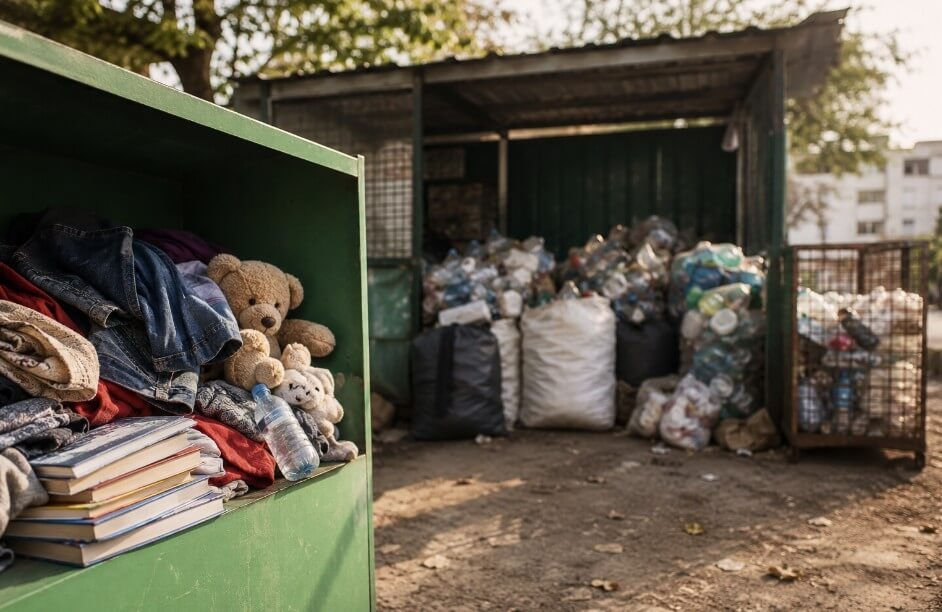
Drive past a municipal ward office in Nagpur or Washim, and there is a fair chance you will spot a small board announcing an RRR centre.
The idea sounds straightforward. Bring in old clothes, books, toys, footwear or plastic instead of dumping them with regular household waste, and the material gets a second life. Vidarbha has seen this scheme roll out steadily since 2023, complete with launch events and social media posts.
What is harder to find is a clear, verifiable account of how many of these centres actually function, what they collect, and where the material goes afterwards. That gap between what gets announced and what gets recorded runs through the entire story.
Jump to:
What an RRR Centre Actually Does
Counting the RRR Centres Across Vidarbha
What Happens After the Government Launch
What an RRR Centre Actually Does
RRR stands for Reduce, Reuse and Recycle. The concept was pushed under the Union government's Swachh Bharat Mission Urban 2.0, specifically through a three week campaign called "Meri LiFE, Mera Swachh Shehar" that ran from 15 May to 5 June 2023.
Urban local bodies across the country were asked to set up collection points where households, shops and institutions could drop off used plastic items, clothes, footwear, books and toys.
The official campaign paperwork went further, describing these as one stop kiosks meant for waste donation and onward use, not just disposal.
It is worth remembering that RRR centres were never part of the original Swachh Bharat push from 2014 that most people associate with the scheme's early years. They belong to a later, narrower phase of the programme, one built around a short but intense national drive. The numbers from that drive tell their own story.
The ministry's own figures put the national count at 20,084 RRR centres during the campaign, but only 4,365 of those were permanent structures. The remaining 15,719 were temporary. In other words, most of the country's RRR infrastructure was stood up quickly for a campaign window rather than built as year round civic infrastructure.
The materials targeted by these centres sit in a specific and useful category. Old clothes, books, toys, bags, footwear and clean, dry plastic tend to retain value only if they are kept separate from food scraps, sanitary waste and street sweepings. Once mixed in with the rest, that value disappears fast. An RRR centre is supposed to work as a last clean checkpoint, catching this material before it slides into the general disposal system. The theory also assumes that self-help groups, charities or recyclers are ready and able to take that material and put it to use.
This fits into Maharashtra's broader waste policy language, where terms like circular economy, resource recovery and waste to wealth appear frequently in official documents. RRR centres are small enough to fit into a ward office, a market corner, a school compound or an existing municipal yard, and visible enough to make for a decent campaign photograph.
But their success depends entirely on everything around them working properly, including source segregation by residents, regular collection, transport arrangements, trained staff and an actual reuse or recycling chain waiting on the other end.
When any one of those pieces is missing, the centre stops being useful, no matter how good it looks on a notice board.
Counting the Centres Across Vidarbha
Getting a precise figure for how many RRR centres exist across Vidarbha turns out to be more difficult than it should be for a scheme built around public visibility.
The Union ministry maintains an online locator that is searchable by state, district and city, and officials have pointed to this as proof that the information is public. That is technically accurate, but the locator does not offer a simple, downloadable regional total. There is no single number anyone can pull up for the whole of Vidarbha.
The most cautious and verifiable figure, based on open records that can actually be checked, puts the count at a minimum of 40 identifiable centres or centre locations across the region, with the overwhelming majority of that count coming from Nagpur alone. The real number is very likely higher, but the public record does not support a more confident estimate.
Nagpur offers the clearest picture simply because it has been documented more than once. In May 2023, the Nagpur Municipal Corporation announced RRR centres in 38 Prabhags, with the initiative becoming operational from 20 May that year. The city started from six existing material recovery facilities and expanded the network under the RRR label.
By March 2025, reporting still described Nagpur as having 38 established locations spread across ten zones, but the same report noted that only six of those units were functional, covering six zones, with the remaining four zones expected to be covered by that May. That single detail says a great deal about the difference between a centre that has been announced and a centre that is actually working on a given day.
There is also evidence that the branding stayed in use well beyond the initial campaign. A Nagpur Municipal Corporation notice for Diwali waste collection in 2024 listed named RRR centre points in Zone 2, including one at Anand Talkies and another at the NMC Zone Office. That suggests the RRR label has continued to function as an identifiable node within the city's regular collection network, even after the original campaign wound down.
Outside Nagpur, the record thins out considerably. Washim offers one of the few smaller city examples that can be pinned down with a traceable public report.
A local Marathi news report from May 2023 recorded that the Washim Municipal Council opened an RRR centre at its shopping complex opposite the district general hospital, with the stated aim of collecting household discards such as clothes, footwear, books and plastic for reuse or redistribution to people who needed them.
Amravati shows signs of rollout too, though mostly through municipal social media rather than structured news coverage. The Amravati Municipal Corporation publicly advertised an RRR centre in Ambika Nagar in 2025 as part of a collection and distribution drive.
That confirms the centre exists and tells residents where to bring items, but it says nothing about how much material actually came in, how much was reused or recycled, or how often the centre was staffed and open.
Across Vidarbha, this pattern repeats. Launches and drives are easy to find. Ongoing performance data is not.
What Happens After the Launch
The real test for any RRR centre is not whether it opens but whether it keeps reusable material out of the wider, messier waste stream. On that measure, Nagpur again provides the most documented and least reassuring picture.
The city's RRR rollout was explicitly tied to reducing pressure on the Bhandewadi dumping yard. The logic is sound on paper. Dry waste diverted at ward level should mean less mixed waste heading for dumping or processing. But the rest of Nagpur's waste record does not support the idea that this is happening at any meaningful scale.
A social audit conducted in the Dharampeth zone in 2025 identified 113 garbage vulnerable points across the area. Of these, 95 per cent contained plastic, paper and glass, and 81 per cent contained organic waste mixed in. That points to a basic segregation failure at source. If recyclable and reusable material keeps turning up in open garbage spots at that scale, the RRR system is not intercepting nearly enough of it early enough. The audit also flagged weak enforcement, poor citizen engagement and gaps in regular collection, conditions under which an RRR centre can only ever play a marginal role.
Figures from early 2026 make the scale of the problem even clearer. Nagpur generated roughly 46,500 metric tonnes of municipal waste in January 2026. Official records cited in local reporting showed only 20,275.34 metric tonnes, or 43.6 per cent of that total, were handed over for processing that month.
Close to 26,000 metric tonnes stayed outside the processing stream altogether, with a substantial share reportedly still heading to Bhandewadi. RRR centres, however well run, can only skim off a narrow slice of dry recyclable and reusable material. They cannot make up for a city where more than half of all waste generated in a given month is not being processed at all.
A state level audit backs up this picture from a wider angle. The performance audit on waste management in urban local bodies, covering the period from 2016-17 to 2020-21 and updated through 2021-22, found that 41 per cent of waste across Maharashtra remained uncollected in 2021-22. It also found that 64 per cent of the 45 urban local bodies tested failed to meet the benchmark for household level collection coverage.
The same audit recorded biomedical waste mixed with solid waste in many locations, e-waste mixed with solid waste in 24 of the 45 bodies tested, and noted that 25 per cent of collected waste in those bodies went unprocessed in 2021-22. In 26 of the 45 bodies tested, sanitary landfills had not even been developed.
That audit is not about RRR centres specifically, but it describes the system these centres are meant to feed into. If collection coverage is patchy, segregation at source is inconsistent and processing capacity remains incomplete, then a scheme that depends on residents bringing in relatively clean material will always be working against a much stronger current pulling in the opposite direction.
There is a second, quieter problem running through all of this, and it concerns reporting rather than infrastructure. Municipal bodies across Vidarbha are generally happy to publish launch photographs, ward level campaigns and appeals for donations. Far fewer publish centre wise monthly figures on how much material came in, what category it fell under, how much was reused, how much was recycled, how much was rejected, how long it sat in storage, or where it eventually went.
For a scheme built entirely around visible behaviour change at the household level, the numbers that would actually prove its worth are largely missing from the public domain. That absence makes it easy for the scheme to look more effective than it can currently be shown to be.
None of this means the idea itself is flawed. RRR centres are a genuinely practical response to a real problem, and cities across Vidarbha have shown they can be set up quickly when there is a campaign push behind them.
What the region cannot yet show, based on what is publicly available, is a reliable answer to a much simpler question that on an ordinary Tuesday, with no campaign running and no notice board freshly painted, how many of these centres are actually open, staffed and taking in material as intended?
Similar Articles
FAQs
Q: What is an RRR centre under Swachh Bharat Mission Urban 2.0?
A: An RRR centre is a Reduce, Reuse and Recycle collection point set up by urban local bodies, mainly through the 2023 "Meri LiFE, Mera Swachh Shehar" campaign. Residents can drop off used plastic items, clothes, books, toys and footwear so the material can be reused, redistributed or recycled rather than mixed into general household garbage.
Q: How many RRR centres are there in Vidarbha?
A: A precise, region-wide total is difficult to confirm because the official government locator is searchable by location but does not provide a simple downloadable count for the whole region. Based on verifiable open records, at least 40 centres or centre locations can be identified, with 38 in Nagpur, one confirmed in Washim, and one publicly advertised in Amravati.
Q: Why is it hard to check whether RRR centres in Vidarbha are actually working?
A: Municipal bodies tend to publish launch events, ward campaigns and donation appeals far more often than they publish operational data. Regular figures on material inflow, reuse rates, recycling volumes, rejected waste, storage time or final destination are rarely made public, which makes it easy to confirm a centre exists but hard to confirm how well it is functioning.
References
Press Information Bureau. (2023, August 7). 'Meri LIFE, Mera Swachh Shahar' campaign. https://www.pib.gov.in/PressReleaseIframePage.aspx?PRID=1946306
Swachh Bharat Mission Urban. (2023). #RRR4LiFE: Meri LiFE, Mera Swachh Shehar documentation. https://sbmurban.org/storage/app/media/Meri_LiFE_Mera_Swachh_Shehar_documentation.pdf
Chakraborty, P. (2023, May 15). NMC's RRR push: 'Reduce, Reuse, Recycle' at prabhag levels begins. The Times of India. https://timesofindia.indiatimes.com/city/nagpur/nmcs-rrr-push-reduce-reuse-recycle-at-prabhag-levels-begins/articleshow/100238029.cms
Bhattacharya, K. (2025, March 18). Lesson learnt, NMC to cross 'Garbage-free City' hurdle in Swachh Sarvekshan '25. The Hitavada. https://www.thehitavada.com/Encyc/2025/3/18/Lesson-learnt.html
Nagpur Municipal Corporation. (2024, October 21). Swachh Diwali Shubh Diwali: List of collection centers 2024 [PDF]. https://nmcnagpur.gov.in/assets/300/2024/10/Public-Notices/NMC__Diwali_Waste_Colletion_Center_21_10_2024_%281%29.pdf
Tarun Bharat. (2023, May 21). आर. आर. आर. केंद्राचे उद्घाटन [Inauguration of RRR Centre]. https://www.tarunbharat.net/Encyc/2023/5/21/Inauguration-of-RRR-Centre.html
Comptroller and Auditor General of India, Principal Accountant General Maharashtra. (2025). The performance audit on waste management in urban local bodies [Report overview]. https://saiindia.gov.in/ag/mumbai-i/en/audit-report/details/121872
Comptroller and Auditor General of India. (2025). Chapter 3: Effectiveness and efficiency in management of waste [PDF]. https://saiindia.gov.in/uploads/download_audit_report/2024/7-Chapter-3-067e4e58aaf0a69.24761273.pdf
Chakraborty, P. (2025, October 11). Tony Dharampeth has 113 garbage vulnerable spots. The Times of India. https://timesofindia.indiatimes.com/city/nagpur/tony-dharampeth-has-113-garbage-vulnerable-spots/articleshow/124464110.cms
Chakraborty, P. (2026, February 26). Only 44% waste processed, 'zero dumping' claim falls flat. The Times of India. https://timesofindia.indiatimes.com/city/nagpur/only-44-waste-processed-zero-dumping-claim-falls-flat/articleshow/128792993.cms
Centre for Water and Sanitation. (2023, August 26). Regional policy dialogue in circular economy [PDF]. https://cwas.org.in/resources/file_manager/SEI-SCF%202_Regional_Policy_Dialogue_in_Circular_Economy_cwas_India_26.08.2023_SHARE.pdf
Amravati Municipal Corporation. (2025, November 20). RRR-based collection and distribution drive at Ambika Nagar [Social media post]. https://x.com/amcamravati/status/1991111872821739637


Comments