_edited.png)
Vidarbha Burn Care Crisis: No Skin Bank, Few Working Units

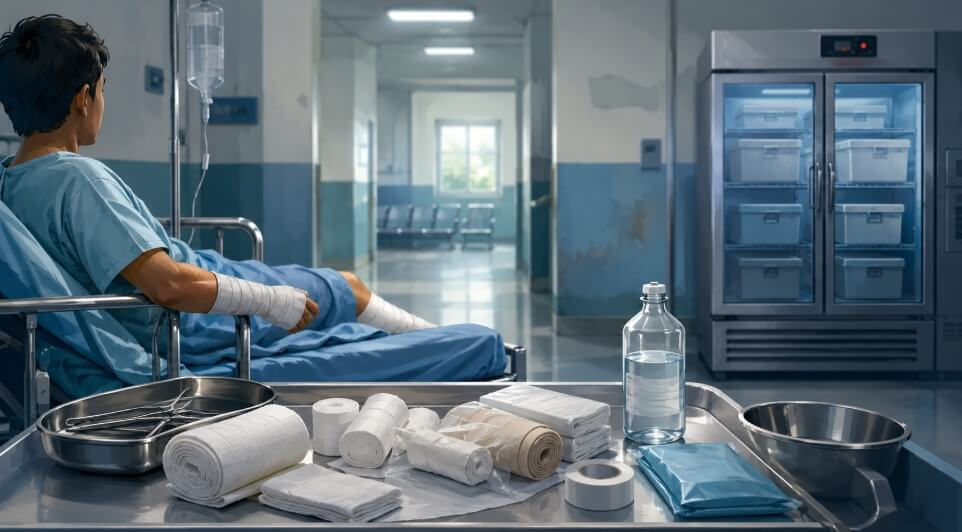
A factory explosion near Kalmeshwar in March 2026 sent dozens of badly burnt workers towards hospitals in Nagpur, and within hours the same old problem surfaced again.
There was no functioning skin bank anywhere in the region and no dedicated burn unit that families could rely on. This is not a new story for Vidarbha. It is a shortage that has been documented, reported and revisited every few years, through festival injury spikes, house fires and now an industrial disaster.
For a region that sends its most serious burn cases to Nagpur from towns hundreds of kilometres away, the absence of this basic infrastructure changes outcomes in ways that are measurable.
Jump to:
Nagpur Burn Units: What Hospitals Claim vs What Is Actually Functional
There is a real difference between a hospital website that lists burn beds and a hospital that can actually treat a severe burn patient on the day they arrive.
A working burns service needs isolation wards, infection control, trained nursing staff, dedicated operation theatres, grafting support and, for the worst cases, access to donor skin when a patient does not have enough of their own left to graft. That last piece is where Vidarbha keeps falling short.
On paper, the region does not look empty. Indira Gandhi Government Medical College and Hospital in Nagpur still lists 24 service beds under the burn category on its official hospital page. Government Medical College and Hospital, Nagpur, describes a specialised burn unit and burn ward within its surgery department. Government Medical College, Akola, lists a 20-bed burn isolation ward as part of its surgery facilities. AIIMS Nagpur, which started its plastic surgery department in June 2022, says a separate Burns Department is still planned for a future building.
Reporting from March 2026 told a different story on the ground. The 40-bed burns ward at GMCH was not functioning because it was under renovation. The skin bank that had been shifted there from Orange City Hospital had also stopped working.
The burns unit at IGGMCH was unavailable because its old building had been demolished to make way for new construction. This meant that at the exact moment a mass-casualty burns disaster hit the region, the city carrying the heaviest referral load for burn patients had no working public skin bank and no functioning specialised burns unit.
This gap between listed capacity and real-time functionality sits at the centre of the problem. A hospital can carry the administrative memory of a burns department for years without that department being open to patients. Families do not need a listing. They need a ward that is staffed, sterile, and connected to surgery and grafting facilities on the day it matters.
The state-level picture explains why serious cases keep travelling upward through the system rather than being treated locally. Maharashtra's public health department notes that district hospitals have separate burn wards sanctioned with five beds for men and five for women.
National operational guidelines for district burn units describe a similarly modest structure, with six beds, including two for acute care, along with basic infection-control equipment.
That is a starting framework, not a tertiary burns centre. It does not include a skin bank, modular burns operation theatres, dedicated isolation areas, hydrotherapy facilities or a trained reconstructive surgery team. When burns are extensive, a district ward becomes a stop on the way to Nagpur rather than the place where treatment is completed.
A skin bank is the piece that sits in the middle of this shortfall. It stores skin donated after death, processes it, and makes it available for temporary use on patients with severe burns.
It is not a permanent replacement for a patient's own skin. It buys time, reduces fluid and heat loss from exposed wounds, and helps control infection while the patient is prepared for further grafting.
Doctors in Nagpur have repeatedly pointed out that for patients with burns covering more than 40 per cent of their body, this kind of support can make a real difference to clinical outcomes.
Burn Patient Survival Rates and the Travel Distance Problem in Vidarbha
For much of Vidarbha, the first obstacle in burn treatment is not the operating theatre. It is the road.
A study carried out by the plastic surgery department at GMCH, reported in November 2022, analysed patients who reached the hospital between 2016 and 2020 and found a sharp rise in deaths as travel distance increased.
Among patients who came from more than 100 kilometres away, nearly 48 per cent died during treatment. Among patients who came from under 10 kilometres, the reported death rate was 25 per cent.
The same report noted that serious burn cases from five districts in Nagpur division were being referred to GMCH because local government hospitals lacked the facilities needed for advanced burns treatment.
The head of plastic surgery at GMCH summed up the problem in a short remark, saying that travel itself is risky for burn patients. He added that a safe transfer requires an intensive care ambulance, trained staff on board, and continuous fluids during the journey, and that very few patients receive all three. That single line captures what the service gap looks like from inside a moving ambulance.
It usually starts with a referral from a rural or district hospital. It becomes a search for transport that can keep a badly burnt patient stable over long distances. It often ends in Nagpur, where the family then has to find a bed, medicines, dressing material, blood support, attendants, food and somewhere to stay.
The difficulty does not end once the patient reaches the city. In March 2026, doctors and hospital associations said that private hospitals in Nagpur were being forced to manage serious burn cases inside routine intensive care units, simply because there was no functioning specialised public burn unit and no working skin bank available.
Modern burns care requires technical systems such as negative pressure arrangements for infection control, and most hospitals in the region do not have this equipment. A shortage that starts as a public health planning gap ends up as a bedside problem inside a private ICU, adding to the strain on families who did not expect to be managing this level of complexity.
This is where the shortage affects ordinary people most directly. Burn treatment is rarely resolved in a single day. National guidelines for burn units note that these injuries often require prolonged hospital stays, repeated plastic surgery procedures, physiotherapy and psychological support, all of which add to the financial burden on a family.
In Nagpur's own experience over the past two years, the transfer itself has been hazardous, the main referral hospitals in the city have been partly non-functional, and private hospitals have had to absorb severe cases without the complete burns infrastructure that such patients are supposed to reach.
The burden is not limited to rare industrial accidents.
In October 2025, a single Diwali night in Nagpur produced more than 30 reported burn injuries across AIIMS, GMCH, IGGMCH and private hospitals combined. Two children, aged four and eight, with severe facial burns were admitted to AIIMS Nagpur. GMCH reported 11 firecracker-related burns cases that night alone, with patients ranging from a seven-month-old infant to a 49-year-old adult. IGGMCH reported six further cases.
These figures show that the shortage is felt during mass-casualty events and during the ordinary seasonal caseload alike. The missing service is not sitting unused for most of the year. Demand for it reaches children, women, industrial workers and families dealing with routine domestic accidents.
Nagpur Skin Bank Closure: Five Years of Failed Revival Attempts
The last five years form a fairly clear pattern. In early 2020, a widely reported burns case from Hinganghat was taken to Orange City Hospital and Research Institute in Nagpur with roughly 40 per cent burns.
At the time, the city still had a recognised destination for burns treatment, though the skin bank at Orange City Hospital was already winding down.
By 2024, that closure had turned into a longer-running institutional failure. The region's first skin bank had remained non-functional for five years. The skin bank, launched a decade earlier at Orange City Hospital, had operated for six years, received 35 donations and helped more than 60 burn patients.
About 10,000 square centimetres of donated skin had been preserved and used on patients before the facility shut down. The equipment was later shifted to GMCH, but the skin bank never resumed operations there. Both GMCH and IGGMCH had separate burn wards that were lying unused.
This history shows that the region did not simply fail to build a skin bank once. It failed to keep one running after it had already proved its value. The issue by this point was not about starting something new. It was about continuity that never materialised.
Two major fire incidents in 2025 pushed the issue back into public attention. In June 2025, the victims from the Mahal house fire were being treated at GMCH, the only tertiary government referral centre for burn victims in the region. During this time, a modern skin bank proposal was still pending approval.
An earlier report from April 2025 said GMCH was preparing two separate proposals for reviving burns infrastructure, one valued at Rs 8 crore and a larger one at Rs 50 crore.
The bigger proposal included a skin bank linked to a 10,000 square foot integrated burn unit, complete with a sterile processing laboratory, a tissue processing room, deep-freezer storage, two modular burn operation theatres, an eight-bed intensive care unit, a 12-bed isolation ward, hydrotherapy dressing rooms and rehabilitation spaces. The level of detail in that proposal shows just how much infrastructure has been missing from the existing setup for years.
Then came March 2026. Following the explosion at the SBL Energy factory in Raulgaon near Kalmeshwar, at least 19 people died and 23 were injured in the immediate aftermath. Within days, the confirmed death toll rose to 22.
Fourteen women remained under treatment at Orange City Hospital, with burns ranging from 30 to 70 per cent of their bodies. The region had to face the same shortage all over again, this time with patients already occupying beds. On 5 March 2026, Nagpur had no operational burn unit and no skin bank at that point in time. That was not a warning about future risk. It was the actual condition under which emergency treatment was being carried out.
The current picture remains uneven. The practical effect is that major burns cases continue to be spread across public hospitals, private hospitals and general intensive care units, rather than being channelled into one reliable burns pathway backed by donor-skin support.
That is the gap families in Vidarbha keep encountering, whether they are dealing with a single household accident or a mass-casualty event involving dozens of patients at once.
Every missing layer in the district-level system adds one more referral, one more search for transport, and one more stretch of time during which a severe burn is being managed without the specialised setup that clinicians say is required.
FAQs
Q: Is there a functional burn unit in Nagpur or Vidarbha at present?
A: The region had no functional skin bank and no fully working dedicated burn unit at that time. Hospital websites still list burn-related beds or units at some institutions, which points to a gap between listed capacity and what is actually operating on the ground.
Q: What happened to the Nagpur skin bank at Orange City Hospital?
A: The skin bank at Orange City Hospital operated for six years, received 35 donations and helped more than 60 patients before it shut down. Its equipment was later moved to GMCH, but reporting from 2024, 2025 and 2026 confirmed that the facility never returned to service.
Q: How does travel distance affect survival for burn patients going to Nagpur?
A: A GMCH study reported in 2022 found that burn patients who travelled more than 100 kilometres to reach the hospital had a death rate of 48 per cent, compared with 25 per cent for patients who came from within 10 kilometres. Doctors have said that safe transfer usually needs an intensive care ambulance, trained staff and continuous fluids during the journey, support that many patients do not receive.
References
Ahmed, S. (2025, October 23). Two kids suffer severe facial burns, 30 suffer injuries by firecracker. The Times of India. https://timesofindia.indiatimes.com/city/nagpur/two-kids-suffer-severe-facial-burns-30-suffer-injuries-by-firecracker/articleshow/124746955.cms
Ahmed, S. (2026, March 5). No skin bank, no functional burn unit in Vidarbha; treatment gaps exposed. The Times of India. https://timesofindia.indiatimes.com/city/nagpur/no-skin-bank-no-functional-burn-unit-in-vidarbha-treatment-gaps-exposed/articleshow/129048006.cms
Ahmed, S. (2026, March 9). 2 more SBL workers succumb, blast toll 22. The Times of India. https://timesofindia.indiatimes.com/city/nagpur/2-more-sbl-workers-succumb-blast-toll-22/articleshow/129288121.cms
All India Institute of Medical Sciences, Nagpur. (2026). About Burns and Plastic Surgery. https://aiimsnagpur.edu.in/AboutPlasticSurgery
Deshpande, C. (2022, November 21). More the distance, less are chances of survival for burns patients. The Times of India. https://timesofindia.indiatimes.com/city/nagpur/more-the-distance-less-are-chances-of-survival-for-burns-patients/articleshow/95646344.cms
Deshpande, C. (2025, April 23). After CM's directive, GMCH set to submit proposals for reviving Nagpur skin bank. The Times of India. https://timesofindia.indiatimes.com/city/nagpur/after-cms-directive-gmch-set-to-submit-proposals-for-reviving-nagpur-skin-bank/articleshow/120529337.cms
Deshpande, C. (2025, June 18). Twin fire tragedies expose urgent need for skin bank. The Times of India. https://timesofindia.indiatimes.com/city/nagpur/twin-fire-tragedies-expose-urgent-need-for-skin-bank/articleshow/121916587.cms
Directorate General of Health Services, Ministry of Health and Family Welfare. (n.d.). Operational guidelines for establishment of burn units in district hospitals under National Programme for Prevention & Management of Burn Injuries. National Health Mission. https://nhm.gov.in/images/pdf/NPPMBI/Operational_Guidelines.pdf
Government Medical College and Hospital, Nagpur. (2026). Department of Surgery. https://gmcnagpur.org/surgery
Government Medical College, Akola. (2026). Surgery. https://gmcakola.in/dept-of-surgery.html
Indira Gandhi Government Medical College & Hospital, Nagpur. (2026). Hospital. https://iggmc.edu.in/opd/
Public Health Department, Government of Maharashtra. (2025). Hospital services chapter. https://cdnbbsr.s3waas.gov.in/s3feecee9f1643651799ede2740927317a/uploads/2025/08/2025081946322959.pdf
Vaidya, V. (2024, June 19). Vid's first skin bank stands non-functional for five years. The Hitavada. https://www.thehitavada.com/Encyc/2024/6/19/Vid-s-first-skin-bank-stands-non-functional-for-five-years.html


thoroughly research report by Pranay