_edited.png)
Blackbuck Decline Forced Urgent Fix at Karanja Sohol Sanctuary

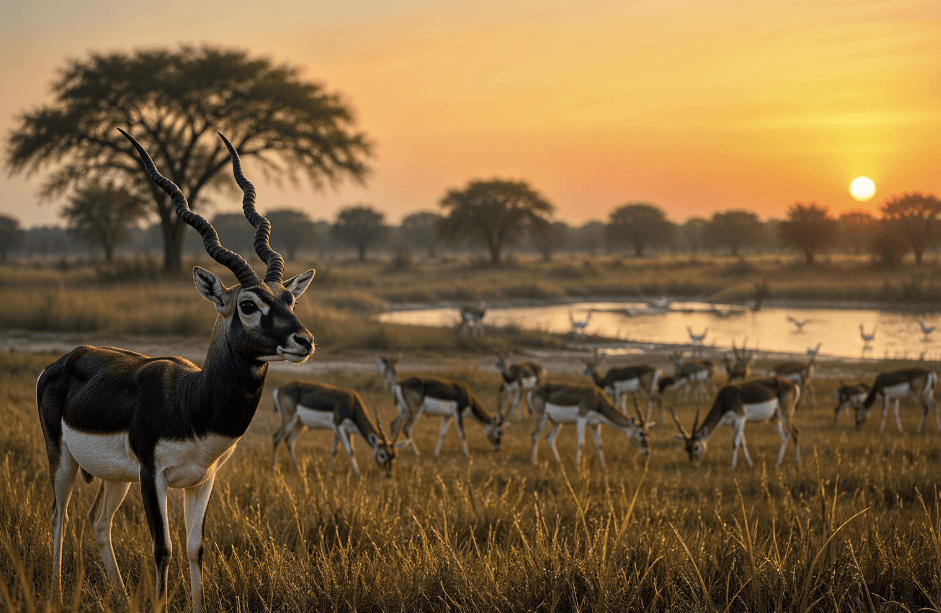
In the Washim district of Maharashtra, a stretch of just over 18 square kilometres of grassland and dry deciduous forest holds one of the few formally protected habitats for the Indian antelope in central India.
The Karanja Sohol Wildlife Sanctuary was officially notified on 7 December 2000, created specifically to stop the decline of the blackbuck in a region where agricultural expansion had steadily eaten into the open plains that the species depends on.
The sanctuary falls within the broader Vidarbha region and is about seven kilometres from Karanja town, situated in a district that is predominantly farmland. What sets it apart from many protected areas is not just its size or its species list but the particular crisis it went through roughly fifteen years after it was established, when the animals it was built to protect began leaving it in large numbers.
The intervention that followed, and the regulations that came after, have since changed how the sanctuary functions and how the land around it is governed.
In this Article:
Administrative Boundaries and Geographical Layout
Trees, Grasses, and the Full Range of Species
The Blackbuck Crisis and the Restoration Response
New Regulations, Road Infrastructure, and Visitor Access
Administrative Boundaries and Geographical Layout
The official notification that created the Karanja Sohol Wildlife Sanctuary designated 18.321 square kilometres of forest and grassland as a protected zone under Schedule I of the Wildlife Protection Act of 1972.
Schedule I classification provides the highest level of legal protection available to a species in India, and the blackbuck was the primary reason the area was chosen. The sanctuary spans parts of both the Karanja taluka in Washim district and the adjacent Yavatmal district.
One of the more unusual features of the sanctuary's layout is that it is not a single contiguous block of land. It is divided into three separate segments, two of which are positioned on either side of the Karanja to Manora highway, and a third that sits across the Karanja to Darva state highway. This fragmentation means that animals attempting to move between sections must cross active roads, and preventing wildlife casualties from road traffic is an ongoing management requirement.
The boundaries of the sanctuary are defined through specific village names and survey numbers, detailed further in a 2020 notification establishing an Eco Sensitive Zone around the core area. The northern boundary is drawn by the Akola Forest Division and sections of the Yavatmal Division.
It incorporates survey numbers from the village of Pasarani, including plots 71, 70, 73, 74, 91, and 90. Mirzapur village contributes survey numbers 1, 13, 14, and 12. Girada village is included with survey numbers ranging from 55 down to 8. Survey number 47 from Imamapur is also part of this boundary, as is an extensive list from Dadagaon that includes plots 48, 49, 50, 51, and several others.
Somathana, Bagapur, and Umbarda villages border the northern sector, with Umbarda contributing survey numbers such as 83 and 81.
In the Yavatmal Division, Hatola village provides survey numbers 432 through 479 to complete the northern demarcation.
The eastern boundary is administered by the Yavatmal Forest Division and involves the western portions of Hatola village and Sangavi. The eastern limit incorporates survey numbers 95 to 98 and 91 to 93 from Sangavi, along with plots 70, 72, and 73.
The southern boundary falls under the Akola Forest Division and draws from Zolgaon, which contributes survey numbers 10, 7, 5, 33, 3, and 1. Dighi village adds plots 37, 36, 41, 42, and others. Januna provides survey numbers 4, 2, 1, and 43. Ramanagar contributes 1, 2, 16, and 21. Pimpari village is represented by survey numbers 9, 7, and 8.
Ekalara village has survey numbers 21, 19, 18, and 36 through 44. Pimpalgaon is particularly significant in the southern boundary, with a large list that includes plots 26, 27, 54, 29, and a series from 101 to 105. Waki and Waghola villages complete the southern limit. The western boundary is entirely within the Akola Forest Division.
The terrain across the sanctuary is largely undulating, producing a varied environment of plateaus and plains.
The Aadan River is the primary drainage channel for the area, and the Aadan reservoir, which lies within the catchment zone, provides aquatic habitat that draws significant numbers of waterbirds.
The soil composition in this part of Vidarbha includes black cotton soil, brown soil, and loamy soil, all of which are suited to the growth of the native grass species that sustain the herbivore population. The region has a long human history as well.
Washim served as the capital of the Vakataka kingdom between the 4th and 6th centuries CE before evolving into the agricultural district it is today.
Trees, Grasses, and the Full Range of Species
The vegetation type of the Karanja Sohol Wildlife Sanctuary is classified as Southern Tropical Dry Deciduous Forest.
Other tree species recorded in the sanctuary include Ain (Terminalia alata), Axlewood (Anogeissus latifolia), Lendia (Lagerstroemia parviflora), Shiwan (Gmelina arborea), Kalamb (Mitragyna parviflora), Indian Rosewood (Dalbergia latifolia), Bija (Pterocarpus marsupium), Khair (Acacia catechu), Salai (Boswellia serrata), Hiwar (Acacia leucophloea), Medshing, and Palas (Butea monosperma).
The grasslands have received particular attention from conservationists because they form the nutritional base for the sanctuary's primary species. Surveys have recorded 41 grass species from 28 genera within the Poaceae family, covering tribal groups including Andropogoneae, Maydeae, Paniceae, and Pooideae. Specific species that are directly important for blackbuck feeding include Pandhari Kusal, Dongari, Marvel, and Shikari. Other grasses on record are Kusali, Kodra, Sheda, and Chikta.
The blackbuck, Antilope cervicapra, is the only living member of the genus Antilope. Adult males carry long, spiral horns with between three and five turns and are identifiable by their dark body coats. Females and juveniles are yellowish-brown and typically do not grow horns. The animals are well adapted to semi-arid conditions and feed on grasses and tender leaves, though they will move onto agricultural land when natural food is scarce.
Beyond the blackbuck, approximately 17 to 20 mammalian species have been documented in the sanctuary. These include the Indian muntjac, striped hyena, sambar deer, jungle cat, wild boar, Indian grey wolf, Indian fox, porcupine, blue bull, and leopard.
The avian count is considerably higher. 151 bird species from 55 families and 17 orders have been recorded.
The order Passeriformes accounts for 41 per cent of total bird diversity. The Aadan reservoir draws migratory waterfowl between November and March each year, and recorded species include the Oriental Honey Buzzard (Pernis ptilorhynchus), Pallid Harrier (Circus macrourus), Bar-headed Goose (Anser indicus), Ruddy Shelduck (Tadorna ferruginea), Comb Duck (Sarkidiornis sylviola), Indian Spot-billed Duck (Anas poecilorhyncha), Green-winged Teal (Anas crecca), Northern Pintail (Anas acuta), Grey Heron (Ardea cinerea), Cattle Egret (Bubulcus ibis), Black-winged Kite (Elanus caeruleus), and Common Peafowl (Pavo cristatus).
Reptile surveys have identified 18 species, including monitors and various snakes.
Three amphibian species and 23 fish species have been found in the streams and water bodies within the sanctuary. Butterfly and spider records total 48 species. A preliminary checklist of dragonflies and damselflies documented 39 species from families including Libellulidae and Coenagrionidae.
Fungal surveys collected 15 species from six families, with macro fungi found in patches at Pimpalgaon and Girda.
This range of species across multiple taxonomic groups reflects the functioning state of the food web within the sanctuary, even though that web was placed under serious stress in the years before restoration work began.
The Blackbuck Crisis and the Restoration Response
In the period following the sanctuary's establishment, no systematic habitat management programme was in place. Without active intervention, the open grasslands that the blackbuck required gradually gave way to dense scrubland.
As the cover of preferred grass species thinned out, the antelope began moving outside the sanctuary boundaries and onto surrounding farmland, where they fed on soybean and cotton crops.
These are among the most economically important crops grown in Vidarbha, and the resulting damage created sustained conflict between farmers and wildlife authorities.
The situation was brought into formal focus in 2015, during a birdwatchers' meet in Washim, where wildlife experts raised documented concerns about the condition of grassland birds and herbivores in the sanctuary. This public acknowledgement contributed to official action the following year. In early 2016, a five-member technical committee was formed, with members drawn from wildlife and grassland management disciplines.
Their remit included reviewing all past management activities within the sanctuary, identifying specific areas requiring habitat manipulation, and proposing a phased schedule of restoration works.
The committee's assessment pointed to the loss of preferred grass species as the direct cause of the blackbuck's departure from the protected area. Acting on this finding, the forest department began cultivating the necessary grass species within the sanctuary through scientifically guided methods.
By July 2017, the committee submitted its findings: the restoration measures had worked. A large proportion of the herbivore population had returned to the sanctuary. Farmers in the surrounding villages also acknowledged that the incidence of crop damage had reduced to a substantial degree.
The episode prompted a shift away from passive boundary enforcement toward active habitat management as the standard operating approach for the site.
New Regulations, Road Infrastructure, and Visitor Access
The 2020 Eco Sensitive Zone notification added a regulatory buffer around the core sanctuary. Under this framework, a Zonal Master Plan is required, covering the restoration of degraded areas, the conservation of water bodies, and the management of catchment zones and groundwater resources.
The plan prohibits the conversion of agricultural or forest land for industrial or residential development within the zone, with the stated purpose of maintaining the ecological integrity of the sanctuary while permitting sustainable activity in surrounding villages.
A separate infrastructure concern involves the Nagpur to Mumbai Super Express Way, which passes through the proposed eco-sensitive zones of the sanctuary.
The forest department and project authorities have responded by planning mitigation structures along the route, including box culverts, minor bridges, viaducts, and vehicle overpasses.
Approximately 1,800 such structures are planned across the entire expressway project. Experts have stated that these are necessary to prevent the fragmentation of habitats and to allow animals, including the leopard and blackbuck, to continue moving across the wider region without being cut off by the road.
The Management Effectiveness Evaluation is the formal tool used to assess how well the sanctuary is being run. These evaluations follow international frameworks and produce results that are used by policymakers and wildlife managers to refine their approach. The sanctuary is listed in the 2024 Environment Statistics for Maharashtra as part of the state's active protected area network.
The stated long-term goal is to grow wild antelope populations across central India by treating connected habitats as single management units rather than isolated parcels.
For visitors, the climate follows typical tropical monsoon conditions. Summer runs from March through May, with temperatures peaking between 45 and 48 degrees Celsius. The monsoon extends from June through October, and the Washim district receives an annual average of approximately 798.70 millimetres of rainfall, most of it arriving between June and September. Winter, from November to February, brings minimum temperatures of around 8 to 10 degrees Celsius and is the more comfortable period for travel.
The recommended visiting window for wildlife sightings is January to June. Animals are most active and visible near water sources between February and May. For bird activity, November to March is the more productive stretch, when migratory species arrive at the Aadan reservoir. The sanctuary is approximately 55 kilometres from Washim city and seven kilometres from Karanja town.
The nearest railway station is Murtizapur on the Nagpur to Mumbai main line, with Akola railhead located about 71 kilometres away. Regular bus services and taxis connect these rail points to the sanctuary entrance. Accommodation options are available in both Karanja and Washim, including the Karanja Government Guest House.
Entry fees and timings are set by the Maharashtra Forest Department and are subject to seasonal changes, so visitors are advised to confirm current status before travel. The Guru Nrusinha Saraswati Mandir in Karanja is a nearby religious landmark that draws its own set of visitors, and many who come to the region combine both stops.
The Karanja Sohol Wildlife Sanctuary sits in a district where the land has always been worked hard. Around it, the fields of cotton and soybean that have defined Vidarbha's agricultural economy for generations press in on its borders, and the expressway that now cuts through the region's ecologically sensitive zones represents the scale of development that protected areas across India must increasingly contend with.
The sanctuary is neither large nor famous. It does not draw the kind of attention that tiger reserves command. What it does hold is a tested example of what happens when grassland management is deprioritised, what it costs, and what it takes to reverse course.
That record is now part of how the site is understood, and in the context of India's expanding infrastructure and contracting natural habitats, it is a record with considerable relevance beyond Washim.
FAQs
Q: What is the Karanja Sohol Wildlife Sanctuary known for, and which species does it protect
A: The Karanja Sohol Wildlife Sanctuary in Washim district, Maharashtra, is primarily known for protecting the blackbuck (Antilope cervicapra), which is listed under Schedule I of India's Wildlife Protection Act of 1972. Beyond the blackbuck, the sanctuary also supports sambar deer, leopard, Indian grey wolf, striped hyena, and over 151 bird species, making it one of the more biodiverse grassland protected areas in Maharashtra.
Q: Why did blackbuck start leaving Karanja Sohol Wildlife Sanctuary, and how was the problem resolved?
A: The blackbuck left the sanctuary because the open grasslands they depend on were gradually replaced by dense scrubland due to a lack of active habitat management after the sanctuary was established. This caused the antelope to move onto nearby farmland and damage crops. In 2016, a five-member technical committee was set up to assess the problem. The forest department then cultivated preferred grass species within the sanctuary, and by July 2017, a significant portion of the blackbuck population had returned.
Q: What is the best time to visit Karanja Sohol Wildlife Sanctuary, and how can visitors reach it?
A: The best period for general wildlife sightings at Karanja Sohol Wildlife Sanctuary is between February and May, when vegetation is low, and animals gather near water sources. Migratory birdwatching is most productive from November to March at the Aadan reservoir. The sanctuary is about seven kilometres from Karanja town and 55 kilometres from Washim city. The closest railway station is Murtizapur, on the Nagpur to Mumbai main line, with Akola railhead approximately 71 kilometres away.
References
Born Free Foundation. (n.d.). Wildlife Heroes: Kishor Rithe. https://www.bornfree.org.uk/wildlife-heroes/kishor-rithe/
Directorate of Economics and Statistics. (2024). Environment Statistics of Maharashtra 2024. Planning Department, Government of Maharashtra. https://mahades.maharashtra.gov.in/files/publication/Environment_Statistics_Maharashtra.pdf
District Collectorate Washim. (2024). About Washim District. Government of Maharashtra. https://washim.gov.in/en/about-district/
Maharashtra Forest Department. (2009). Working Plan for Akola Forest Division. Government of Maharashtra. https://mahaforest.gov.in/writereaddata/managementpdf/1441445480VOLUME%20-%20I.pdf
Ministry of Environment, Forest and Climate Change. (2020, June 12). Notification: Eco-Sensitive Zone around Karanja Sohal Blackbuck Wildlife Sanctuary. Government of India. https://moef.gov.in/uploads/2019/10/karanja-shool.pdf
Pinjarkar, V. (2017, August 1). Black bucks make a comeback in Karanja-Sohal park. The Times of India. https://timesofindia.indiatimes.com/city/nagpur/black-bucks-make-a-comeback-in-karanja-sohal-park/articleshow/59853311.cms
Shirbhate, M. V. (2013). Morphotaxonomic study of poaceae of Karanja (Lad) Sohol Black Buck Sanctuary. Vidyawarta Interdisciplinary Multilingual Refereed Journal, 1(1), 32-37. https://www.viirj.org/vol1issue1/8.pdf
Shirbhate, M., & Shirbhate, A. (2014). Preliminary checklist of damselflies and dragonflies (Insecta, Odonata) of Karanja Sohol Wildlife Sanctuary. Shankarlal Khandelwal College. https://www.khandelwalcollege.edu.in/pdf/research_ppr_332A/41...Shirbhate.pdf
Suradkar, S., Shirbhate, M., Ingle, P., Sawdekar, M., Sawant, A., Shirbhate, A., & Dhongle, S. R. (2023). Study on avifauna and species richness in Karanja-Sohol wildlife sanctuary, (MS) India. Environment Conservation Journal, 24(4), 206–213. https://journal.environcj.in/index.php/ecj/article/view/2309
Wildlife Institute of India. (2025). Management Effectiveness Evaluation (MEE) of National Parks and Wildlife Sanctuaries in India. Ministry of Environment, Forest and Climate Change. https://v1.wii.gov.in/images//images/documents/mee/MEE%20REPORT_compressed.pdf
Wikipedia. (2024). Karanja Sohol Wildlife Sanctuary. https://en.wikipedia.org/wiki/Karanja_Sohol_Wildlife_Sanctuary


Comments