_edited.png)
Inside Nagpur’s Narrow Gauge Rail Museum and Its Rare Railway Past


At Motibagh in Nagpur, a museum keeps hold of a railway system that stopped running years ago but never really left public memory.
This is not a display set up far from the tracks it talks about. It occupies the very ground where locomotives were once repaired and coaches marshalled at the heart of a rail network that defined daily life across Vidarbha for over a century. Families in the region did not read about this railway in books.
They travelled on it, sent goods through it and depended on it to reach markets and towns. The museum brings all of that back within reach, standing exactly where much of the original work took place.
Jump to:
Narrow Gauge Rail Museum Nagpur History and Origins
The Narrow Gauge Rail Museum opened its doors on 14 December 2002 and is listed in Indian Railways documentation as the Narrow Gauge Rail Museum and Photo Gallery, Motibagh, Nagpur. The Ministry of Culture places it on Kamptee Road in Moti Bagh, Mohan Nagar, near Kadbi Chowk.
The site was not picked at random. It sits on the former South Eastern Railway broad-gauge steam locomotive shed, so the museum occupies a plot where actual railway operations once took place rather than a location chosen purely for convenience.
This location ties directly into what the museum represents. Nagpur Division once ran one of the largest narrow gauge systems in the country, a network stretching beyond 1,005 kilometres that formed part of what is known in museum circles as the Satpura railway world.
The line ran on the 2 ft 6 in gauge that carried much of central India's light rail traffic for decades. By 1913, the Satpura network had become the largest narrow gauge railway system anywhere in India, linking Nagpur and Jabalpur with Chhindwara and reaching further towards Nagbhir and Chanda Fort. These lines began mostly to support agricultural movement and famine relief work, and over time, they turned into ordinary passenger routes used by thousands of commuters.
The museum owes its existence partly to how completely that system disappeared. The Nagpur Chhindwara passenger service made its final journey on 30 November 2015. The last surviving stretch, the roughly 110-kilometre Itwari Nagbhir section, shut down for gauge conversion on 25 November 2019.
Once that closure happened, narrow-gauge rail travel in Nagpur Division came to a complete stop. For generations before that point, these lines had carried market produce, daily wage workers, students and railway staff across the wider Vidarbha belt. The museum at Motibagh turned that vanished network into something people could walk through and see for themselves, rather than something only recalled in conversation.
Scale sets this museum apart from a typical small-town railway display. It spreads across several acres and combines indoor exhibition halls with an open yard packed with preserved rolling stock.
That size gives the museum room to present narrow gauge rail as a full working system, complete with its machinery, its paperwork and its daily operations, rather than reducing it to a couple of engines parked for photographs.
Locomotives, Coaches and Exhibits at Motibagh Museum
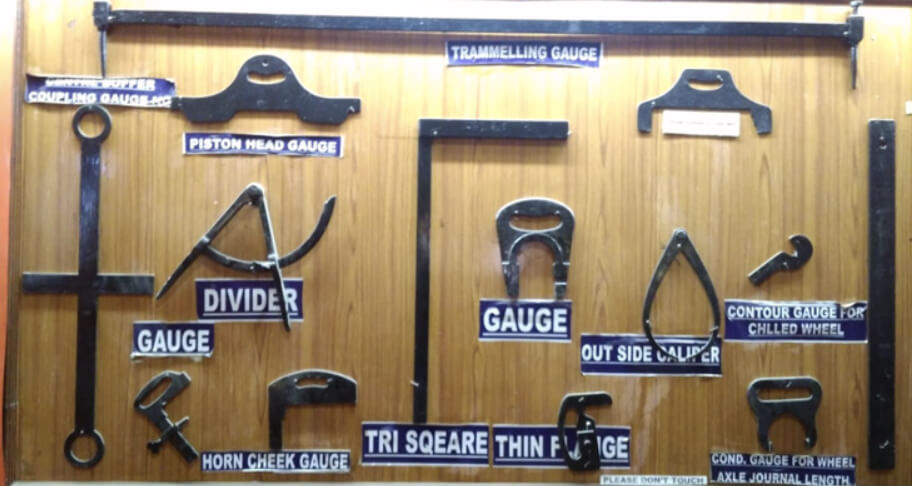
The indoor galleries are built around the departments that once kept the railway functioning. There are sections built around locomotives, coaches and wagons, and signal and telecom equipment, along with other operational areas.
Photographs, scale models, physical components and visual panels do most of the work here, rather than long written labels.
The Heritage gallery holds some of the more surprising pieces. German-silver cutlery once used in royal carriages sits alongside a coal-fired oven, a foldable wash basin, collections of postage stamps tied to Indian and foreign railways, and a set of old technical bulletins, manuals, reports and letters.
These smaller items give the museum a personal dimension, revealing the everyday habits of railway travel, maintenance and administration rather than just the engines themselves.
The outdoor yard widens the picture further. Preserved locomotives at Motibagh include B5, a 1907 narrow gauge steam locomotive built by W.G. Bagnall of Stafford, and CC 677, another 1907 locomotive built by North British Locomotive Company in Glasgow.
The wider Motibagh precinct also holds BS 615, a 1915 locomotive built by Nasmyth Wilson. Together, these entries show that the museum does not treat narrow gauge history as one single era. It places early steam engineering, later repair work and the eventual move to diesel power within the same physical setting.
That move to diesel carries particular weight in Nagpur. The Motibagh narrow gauge diesel loco shed began operations in October 1964, starting out with a fleet of 15 ZDM 2 diesel locomotives imported from Germany, fitted with Maybach engines and imported transmission systems.
Over the following decades, the shed took on further locomotive classes, including ZDM 3A, ZDM 3B and ZDM 4A. A 1964 ZDM2RA locomotive counts among the highlighted diesel exhibits today. Diesel power did not arrive as a clean break from steam at Motibagh. The shed stayed central to narrow gauge operations well after steam engines stopped dominating the network.
The coach and wagon collection adds even more depth. Rail buses SEC 7041 and SEC 7040, both marked EZZS, sit at Motibagh alongside the royal saloon SEC PL 1 GFQ, coaches such as RB 1 and RB 8, and other passenger stock under the GFF, GSPPH, GC and RH classes. On the freight side, the yard holds PRS wagons, BTP stock, BKC wagons, a B-class wagon and a KC four-wheeler open wagon.
This kind of technical listing might read as dry on paper, but seeing it in person shows just how wide the collection really is. The site works less like a themed attraction built for families and more like a preserved railway environment that happens to welcome visitors.
A wooden-bodied royal carriage dated 1899, connected to the Paralakhemundi royal family, stands near the Bagnall steam locomotive and the diesel-era exhibits.
That arrangement creates a clear line running from princely travel through rural transport to industrial change. Few heritage sites anywhere in Vidarbha manage to connect courtly journeys, public transport and workshop labour so directly within a single visit.
The toy train remains the most recognised feature for casual visitors, though it is not simply an attraction bolted on to draw footfall. It circles the museum grounds and continues to be one of the most talked-about parts of any visit, largely because the museum already offers substance inside its halls and along its tracks.
Satpura Railway Network and Its Importance to Vidarbha
The museum's real value lies as much in what it preserves about the Satpura railway as in the machinery on display.
A history compiled by Ravindra Bhalerao for Google Arts and Culture notes that the narrow gauge network around Nagpur ranked among the two biggest such hubs in the entire country, alongside Vadodara.
The same account states that by the time India became independent, Nagpur and Vadodara together made up 1,650 kilometres out of the country's total 5,198 kilometres of narrow gauge track. Nagpur was never a minor footnote in this story. It stood as one of its central points.
The line mattered because ordinary people needed it every day. A separate account published by the Rail Enthusiasts' Society on Google Arts and Culture notes that hundreds of villages depended on the train, with traders making weekly trips into Nagpur to restock their shops. Sir Mark Tully, recalling his own travels on the Satpura system, called the line their lifeline. That single word captures what the museum ultimately protects. This was never simply a subject for railway enthusiasts.
Across large parts of Vidarbha and its neighbouring districts, narrow-gauge rail formed part of ordinary transport, moving labour, goods and daily supplies over a wide stretch of central India.
The museum keeps the working side of the railway just as visible as its more attractive elements. The galleries cover signalling and telecommunications equipment in detail. The yard preserves freight wagons with the same care given to royal saloons. Documents, manuals and bulletins keep the administrative history in view alongside the physical hardware. The locomotive collection links Nagpur to manufacturers in Britain and to later diesel imports from Germany.
The history of the Motibagh shed shows how Nagpur connected onward into the broader Satpura region of central India. Taken together, these pieces turn the museum into a record of how an entire transport system was built, maintained and kept running across more than a hundred years.
Visitors continue to respond strongly to what they find there. In 2026, a visitor from California touring historic sites across India summed up the collection in three words, calling it terrific. The remark is short, but it fits the experience on offer.
Nobody has to take railway history on faith at this museum. Visitors stand in front of preserved steam and diesel locomotives, saloons, rail buses, wagons, tools and paper records that once belonged to one of the most extensive narrow gauge systems the country has ever had.
Narrow Gauge Rail Museum Nagpur After the 2024 Fire
The museum's recent history includes a serious setback. In March 2024, a fire at the Motibagh site damaged heritage literature, miniature engines, documents and artefacts from the British period, with losses estimated at around Rs 75 lakh.
The fire affected four sections of the site, including the office, a mini theatre, archival galleries and a storeroom holding railway documents, stamp collections and electronic equipment. The damage carried weight because so much of the museum's worth rests in its records and interpretive material, not only in the larger rolling stock kept outdoors.
Recovery since then has been visible on the ground. By January 2026, the museum had reopened with its major exhibits intact and with noticeably higher visitor numbers. Family groups, school trips and weekend visitors returned in greater numbers, joined by tourists from abroad as well.
Around 75 major exhibits were restored during the renovation work that followed the fire, according to official social media posts connected to Indian Railways heritage promotion. The museum that reopened was not identical to the one that burned, but it stood functional again and clearly geared towards regular public use rather than merely surviving as a static site.
The rebuilt visitor experience blends preservation work with public-facing features more openly than before. Recent additions include manicured grounds, children's play zones, a toy train ride, food kiosks, an ice cream parlour, gaming sections and spaces set aside for small private functions. Work has also gone into reviving a revolving restaurant housed inside a rail coach, along with plans for a souvenir outlet.
Some of these additions may appeal more to families out for a day trip than to dedicated rail enthusiasts, but they have not pushed the core collection to one side. They have increased the time visitors spend at the site and kept it in regular use, which matters because heritage sites left unused tend to fall into disrepair faster than those that stay active.
The Narrow Gauge Rail Museum remains one of the few places in Vidarbha where this old railway system can still be examined at full scale. A single visit takes a person from steam locomotives to diesel-era history, from a royal saloon to freight wagons, from signalling equipment to old technical letters.
What comes together is a fairly complete picture of a transport network that once defined how people in this part of the country moved and traded. The narrow gauge trains no longer run through the district, but at Motibagh, that history stays present in metal, paper and public memory.
FAQs
Q: What are the timings and entry fee for the Narrow Gauge Rail Museum in Nagpur?
A: The museum stays closed on Mondays. Adult tickets cost Rs 25 and children's tickets cost Rs 10. A 2026 listing gives visiting hours of 11.30 am to 8.30 pm from Tuesday to Sunday, though seasonal timings may vary slightly depending on the source consulted.
Q: Why is the Narrow Gauge Rail Museum in Nagpur considered historically significant?
A: The museum preserves the history of the Satpura narrow gauge network, which once made Nagpur one of the largest centres for narrow gauge rail operations in India. It stands on the site of a former railway locomotive shed and includes thematic galleries covering locomotives, coaches, wagons and signalling equipment, alongside preserved rolling stock from both the steam and diesel eras.
Q: What are the main exhibits to see at the Narrow Gauge Rail Museum, Motibagh?
A: Key exhibits include early twentieth-century steam locomotives such as B5 and CC 677, preserved rail buses, a royal saloon, a range of passenger and freight stock, and a Heritage gallery containing railway cutlery, a coal-fired oven, a foldable wash basin, manuals, official correspondence and railway stamp collections. The toy train ride and the outdoor yard of preserved rolling stock remain popular additions alongside the core historical collection.
References
Ahmed, S. (2026, January 25). Nagpur's Narrow Gauge Legacy Finds New Steam. The Times of India. https://timesofindia.indiatimes.com/city/nagpur/nagpurs-narrow-gauge-legacy-finds-new-steam/articleshow/127421662.cms
Bhalerao, R. (n.d.). The toy train's final act - Demise of the Satpura Railway. Google Arts & Culture. https://artsandculture.google.com/story/the-toy-train%E2%80%99s-final-act-demise-of-the-satpura-railway-rail-enthusiasts-society/CwXR9GfAHwlSKw?hl=en
Indian Railways. (2024). Coaches, wagons, saloons & cranes - March 2024. Railway Board, Heritage Directorate. https://indianrailways.gov.in/railwayboard/uploads/directorate/Heritage/2024/3_%20Coaches%2C%20Wagons%2C%20Saloons%20%26%20Cranes%20-%20MARCH%202024.pdf
Indian Railways. (2024). Heritage inventory of Indian Railways. Railway Board, Heritage Directorate. https://indianrailways.gov.in/railwayboard/uploads/directorate/Heritage/Heritage%20Inventory%20of%20Indian%20Railways.pdf
Indian Railways. (2024). List of rail museums / heritage gallery / heritage park over Indian Railways. Railway Board, Heritage Directorate. https://indianrailways.gov.in/railwayboard/uploads/directorate/Heritage/2024/7_%20List%20of%20Railway%20Museums%2C%20Parks%20and%20Galleries%20with%20Estb%20date%20-%20MARCH%202024.pdf
Indian Railways, Mechanical Engineering Directorate. (n.d.). Railway = SECR, shed = Motibagh. https://indianrailways.gov.in/railwayboard/uploads/directorate/mec_engg/downloads/DLS/secr/Moti%20Bagh.pdf
Ministry of Culture. (2023). Directory of Indian museums. Government of India. https://culture.gov.in/files/inline-documents/Directory_of_Indian_Museums_080620231.pdf
Nagpur Tourism. (2026, March 24). Narrow Gauge Rail Museum Nagpur entry fee, timings, history, images, location & entry ticket cost price. https://nagpurtourism.co.in/narrow-gauge-rail-museum-nagpur
Rail Enthusiasts' Society. (n.d.). End of a much loved railway - Narrow gauge around Nagpur. Google Arts & Culture. https://artsandculture.google.com/story/end-of-a-much-loved-railway-narrow-gauge-around-nagpur-rail-enthusiasts-society/lQVBAm-ihwwfLw?hl=en
Symbiosis Law School, Nagpur. (2026, March 7). Heritage walk to the Narrow-Gauge Rail Museum, Nagpur. https://www.slsnagpur.edu.in/news-events/heritage-walk-to-the-narrow-gauge-rail-museum-nagpur
The Times of India. (2024, March 11). Fire at Nagpur's city Narrow Gauge Museum destroys railway history. https://timesofindia.indiatimes.com/city/nagpur/fire-at-nagpurs-city-narrow-gauge-museum-destroys-railway-history/articleshow/108376802.cms


Comments