_edited.png)
Kanhan Yellow Stone: The Sandstone of Nagpur Railway Station

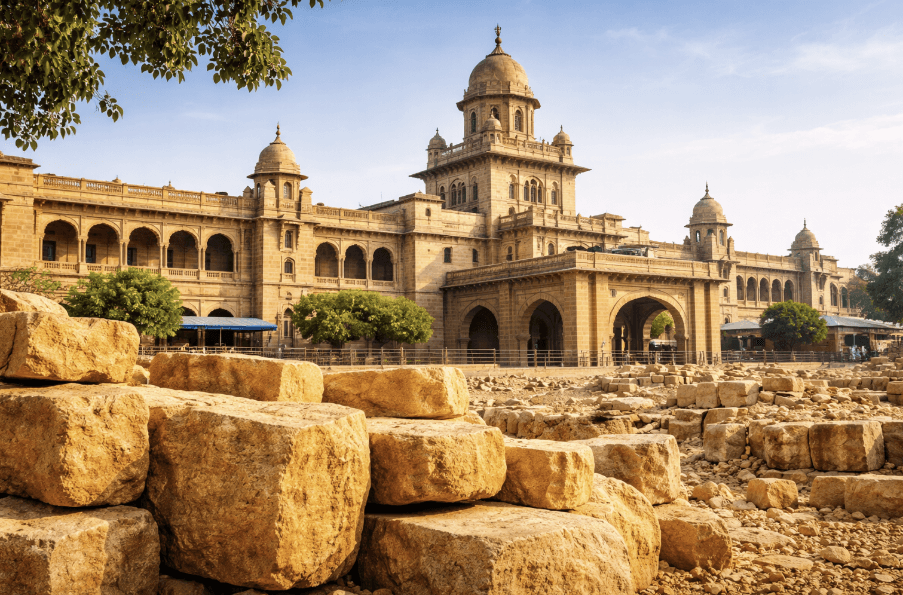
Kanhan Yellow Stone is not a gemstone marketed for jewellery. It is a locally recognised building stone, best known for its use in the heritage masonry of Nagpur railway station and for the belt of quarries and outcrops linked to the Kanhan River and the coalfield country north of Nagpur.
In Vidarbha, the term is most often heard when a major façade is discussed, repaired, cleaned, or matched with new stone for like-for-like replacement.
The material sits at the junction of geology and construction, where a stone’s grain size, colour, bedding, and surface behaviour decide how a civic building looks after decades of soot, rain, and repeated handling.
The same stone also carries a paper trail in mining and administrative records, because sandstone beds in this district have long been worked for blocks and slabs.
What Kanhan Yellow Stone is in geological terms
Kanhan Yellow Stone is essentially a yellowish to buff sandstone used as a dimension stone. In the Nagpur district setting, the stone is connected in official stratigraphic descriptions to the Gondwana sedimentary sequence, where the Kamthi unit is repeatedly described as sandstone rich, medium to coarse grained, and ferruginous in character.
In the Kamptee coalfield area, a National Mineral Exploration Trust project proposal lists the Kamthi unit as an Upper Permian formation and describes it as yellowish brown medium to coarse grained ferruginous sandstone with occasional shale or clay bands. The same table places this sandstone above the older Motur and Barakar units and below the younger cover rocks and soils that dominate the surface in many parts of the district.
The yellow tone that gives Kanhan Yellow Stone its name is closely tied to iron staining and ferruginous bands that sit within otherwise quartz-rich sandstones.
A stratigraphic lexicon entry for the Kamthi formation describes grits and sandstones that are frequently iron stained, with hard ferruginous bands, and notes that associated fine mudstones can be yellow in fresh sections and turn red on exposure. The point for builders and conservators is straightforward. Colour is not just a paint like surface feature. It comes from the chemistry and cement of the rock, and that chemistry decides how the stone ages on a façade once it is cut and exposed.
Depositional interpretation helps explain why this sandstone is workable in large pieces. Research published by the Gondwana Geological Society on Kamthi sandstones in the Umrer coalfield describes distinct lithofacies associated with a meandering river environment, including channel floor and channel fill deposits, point bars, and overbank deposits that show fining upward cycles. The same abstract groups Kamthi sandstones into wackes and arenites, a classification that signals a practical range from cleaner sandstones to more matrix-wide varieties.
This kind of fluvial bedding and repetition is a reason why sandstone in this belt can appear in long runs of blocks. It also explains why quarries and construction projects may prefer particular beds that split cleanly and retain a uniform yellow or buff look on the dressed face rather than showing patchy red streaking.
In Vidarbha, the geological story is also tied to where the sandstone appears at all. The Deccan Trap basalts cover a large part of Maharashtra, so older sedimentary beds show through in specific belts, basins, and cuttings rather than as continuous exposures.
The Directorate of Geology and Mining in Nagpur lists Lower Gondwana units, including the Kamthi formation, as sandstone and shale bearing and places them within the state’s broader stratigraphic sequence.
This is one reason the stone becomes a local material. It tends to be quarried where it is exposed, then consumed in the same district or adjacent corridors because transport costs can quickly outweigh the value of a mid range building stone.
Where the stone comes from and how quarrying developed around the Kanhan belt
The immediate supply geography of Kanhan Yellow Stone is best understood as a belt rather than a single pit.
In a Nagpur Forest Division working plan, the district’s mineral section notes that clay deposits are associated with the Kamthi formation and adds that Kamthi sandstone yields good building stones. It then states that a number of quarries are located at Silewara and Bokhara.
This is not a market brochure claim. It is a planning statement embedded in an administrative document that also lists other district mineral resources, which means the sandstone is treated as an established building stone supply rather than a minor or experimental material.
The longer historical thread runs through older gazetteer style compilations that documented local economic resources. In The Imperial Gazetteer of India, a Nagpur district note records that a quarry of white sandstone is worked at Silewara on the Kanhan river and that long, thin slabs well suited for building are obtained from it.
The wording matters because it points to two features that are still central to sandstone quarry economics. One is bedded splitting that can produce long slabs. The other is the presence of a paler sandstone variant in the same field. In practice, the yellow label used in common speech can sit alongside lighter tones depending on the particular bed, depth, weathering state, and how much iron staining is present.
What this means on the ground is that Kanhan Yellow Stone is less like a factory product and more like a natural series. The same quarry belt can yield stone that looks lighter when freshly cut and more yellow or darker when a surface oxidises or accumulates soot. In older building practice, masons learned which beds dressed well and which layers carried clay partings that could weaken a block.
Later, in larger contracts such as railway or institutional buildings, selection and dressing shifted into a more standardised system, where the stone provided a repeated module for block masonry.
A second supply corridor appears in reporting on the construction materials of Nagpur station, where sandstone is linked not only to Silewara and Bokhara area references but also to Saoner and to quarry names used in local memory and print. The useful point is not to force all these names into a single label. The point is that the stone for major works in this district came from multiple quarries within a manageable radius, creating a supply network that could feed large demands and also deliver replacement stone when needed.
Vidarbha is also a place where stone and rail corridors have been intertwined for more than a century. The quarry references linked to the Kanhan belt sit in a corridor where coalfield development, road links, and rail lines run close together.
That proximity has historically lowered the friction of moving heavy building materials like sandstone blocks and slabs. In effect, the same geography that made Nagpur a rail junction also made nearby sandstone more attractive to institutional builders looking for a durable, locally available material.
How Kanhan Yellow Stone entered Nagpur’s public architecture
Kanhan Yellow Stone becomes most visible to the public on the face of the Nagpur railway station.
The heritage Nagpur railway station building is made of Kanhan yellow sandstone in a classical block style.
Approvals for redevelopment and cleaning were issued with the condition that the main building, classified as a Grade II heritage structure, will not be damaged. In one account, Central Railway officials are quoted as saying, “We will not damage the building but will clean it up,” linking the stone directly to conservation constraints and public attention around façade work.
The station also provides a clean timeline for how a local sandstone moved from quarry beds into high visibility architecture. A Central Railway Nagpur Division note states that the foundation stone of the existing building was laid in 1906 and that it was officially inaugurated on 15 January 1925. The station was designed in a Beaux Art style.
The sandstone from Saoner was utilised in civil works. Walua sandstone used in the building was sourced from Saoner, and those stones were brought from Borgaon and Patkhakheri quarries, about 48 kilometres from the city. The stone washing had been carried out in the past to remove dark circles that formed due to pollution on the exterior surface, showing that surface change on this sandstone has been a visible maintenance issue over time.
These parallel descriptions matter because they show how Kanhan Yellow Stone operates as a practical label in public discussion. The same building can be described using a place-linked name, such as Kanhan yellow sandstone, a quarry-linked name such as Saoner sandstone, and a local material term such as Walua, all pointing to sandstone used as dressed block work. In each case, the focus returns to the same essential fact.
The stone is not an internal structural element hidden behind plaster. It is a visible face stone that defines the building’s appearance and therefore attracts debate whenever cleaning, repair, or redevelopment is proposed.
This is also where the phrase classical block style becomes useful. In everyday construction language, it signals a façade built from repeated, dressed blocks rather than from rubble masonry or plastered brick. That style commits the building to a certain type of repair.
If a block fails, replacement is not only about strength; it is about matching colour, grain, and tooling marks. When cleaning is proposed, the method needs to respect the face of the stone, because overly aggressive washing can change the surface texture and make new patches stand out on a heritage elevation.
Vidarbha’s wider built inventory often includes the same kind of sandstone vocabulary, where public structures use locally available stone for high-visibility elements in order to project solidity and continuity.
Kanhan Yellow Stone sits inside that tradition, not as a decorative afterthought but as a material that carried the weight of institutional construction choices in the early twentieth century and continues to influence how redevelopment projects are planned today.
FAQs
Q: What is the meaning of Kanhan Yellow Stone in construction work in Nagpur and nearby towns?
A: Kanhan Yellow Stone refers to a yellow to buff sandstone used as a building and facing stone, widely recognised through heritage structures where the face masonry is visible and must be protected during repair or cleaning.
Q: Is the Nagpur Railway Station Building made of Kanhan Yellow Stone?
A: Newspaper reporting on heritage clearances and cleaning plans describes Nagpur station’s heritage building as built of Kanhan yellow sandstone in a classical block style. Other reporting on the station’s construction materials describes sandstone sourced from Saoner and from named quarry areas supplying stone for the building.
References
Central Railway Nagpur Division, Commercial Branch. (n.d.). About us. Central Railway. Retrieved February 23, 2026, from https://cr.indianrailways.gov.in/cris//uploads/files/1757049943542-About%20US.pdf
Directorate of Geology and Mining, Government of Maharashtra. (n.d.). Geology of Maharashtra. Retrieved February 23, 2026, from https://mahadgm.gov.in/index.php/Contentpage/index/25/
Gondwana Geological Society. (2020). Sedimentological attributes of Kamthi sandstones from Umrer coalfield, Nagpur District, Maharashtra. Journal of Geosciences Research. Retrieved February 23, 2026, from https://gondwanags.org.in/journal-of-geosciences-research-jgsr/contents/jgsr-2020-vol-5-no-2/sedimentological-attributes-of-kamthi-sandstones-from-umrer-coalfield-nagpur-district-maharashtra/
International Commission on Stratigraphy, Subcommission on Permian Stratigraphy. (n.d.). About the Permian. Retrieved February 23, 2026, from https://permian.stratigraphy.org/
Maharashtra Forest Department. (2004). Working plan for Nagpur Forest Division Volume I. Retrieved February 23, 2026, from https://mahaforest.gov.in/writereaddata/managementpdf/1416046973Volume%20I.pdf
National Mineral Exploration Trust. (2023). Proposal North of Saoner Block coal Kamptee coalfield. Retrieved February 23, 2026, from https://nmet.gov.in/upload/project_registration/6436476936fc05%20Proposal%20North%20of%20Saoner%20Block%20%20Coal.pdf
Parmar, V., & Prasad, G. V. R. (n.d.). Kamthi Formation. Indian Plate entry in Geolex. Retrieved February 23, 2026, from https://indplex.geolex.org/formations/Kamthi%20Fm
The Hitavada. (2025, January 16). Iconic Nagpur Railway Station building turns 100. Retrieved February 23, 2026, from https://www.thehitavada.com/Encyc/2025/1/16/Iconic-Nagpur-Railway-Station-building.html
The Imperial Gazetteer of India. (1908). Volume XVIII Moram to Nayagarh. Oxford Clarendon Press. Retrieved February 23, 2026, from https://archive.org/stream/in.ernet.dli.2015.77057/2015.77057.The-Imperial-Gazetter-Of-India-Vol-Xviii_djvu.txt
The Times of India. (2020, September 12). Heritage panel nod to rly station’s redevelopment. Retrieved February 23, 2026, from https://timesofindia.indiatimes.com/city/nagpur/heritage-panel-nod-to-rly-stations-redevpt/articleshow/78066988.cms
The Times of India. (2024, October 29). Iconic Nagpur rly station building to be stone washed as part of upgrade plan. Retrieved February 23, 2026, from https://timesofindia.indiatimes.com/city/nagpur/nagpur-railway-station-to-undergo-stone-washing-in-major-upgrade/articleshow/114736828.cms
The Times of India. (2025, January 16). Iconic Nagpur Rly Station at 100 locopilot 94 chugs into memory lane. Retrieved February 23, 2026, from https://timesofindia.indiatimes.com/city/nagpur/iconic-nagpur-rly-station100-locopilot-94-chugs-into-memory-lane/articleshow/117276928.cms


Comments